

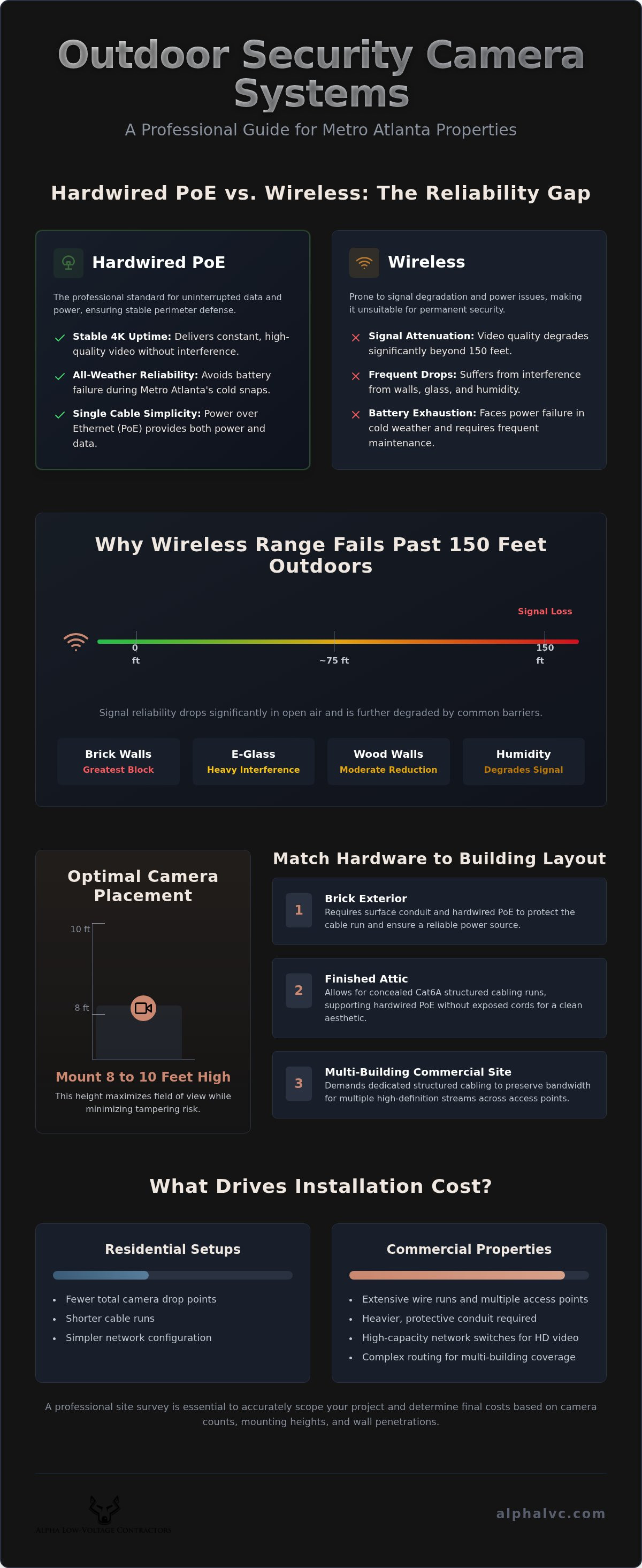
Hardwired Power over Ethernet (PoE) camera networks deliver stable 4K uptime, while modern wireless units suffer signal degradation beyond 150 feet of line-of-sight distance. Selecting the right setup in Metro Atlanta requires evaluating structural barriers, voltage requirements, and strategic placement rules. You can review your property requirements with AlphaLVC to ensure stable perimeter coverage.
Key Takeaways: Install hardwired Power over Ethernet cameras for stable 4K uptime, as wireless signals suffer significant degradation beyond 150 feet or through brick and energy-efficient glass.
- Mount lenses between 8 and 10 feet high to maximize field of view.
- Wireless range fails beyond 150 feet in open air and drops further in humidity.
- Choose hardwired PoE systems for permanent perimeter defense to avoid battery failure during freezes.
- AlphaLVC field records show commercial properties require heavier conduit and high-capacity switches than residential.
Match hardware to your building layout before you buy
Your first decision is whether the building calls for hardwired PoE, structured cabling across multiple access points, or a limited wireless stopgap. Three situations come up often:
- Brick exterior with no attic path: surface conduit and hardwired Power over Ethernet keep the run protected and powered.
- Finished attic above the eaves: concealed Cat6A runs support residential hardwired PoE without exposed cord.
- Multi-building or multi-access-point commercial site: dedicated internet cables (structured cabling) preserve bandwidth so high-definition streams do not compete on one weak hop.
Property layout dictates your hardware selection. With clients we see that brick structures require surface conduit, while finished attics allow concealed runs. DIYers often choose battery power, but residential homeowners need hardwired Power over Ethernet systems. Commercial managers require dedicated internet cables to maintain bandwidth across multiple access points.
Battery cameras fail during cold snaps in Metro Atlanta, so a hardwired backbone is the practical long-term choice for perimeter coverage. You can read the full infrastructure standards before you lock in hardware. High-definition streams suffer signal loss on pure wireless networks; professional installation addresses that gap by matching cable plant to building material. Choose PoE when you want coverage that stays online through weather and distance. More on this: Professional Outdoor Security Camera Installation.
Tip: Mount your cameras between 8 and 10 feet high to achieve a clear field of view.
Hardwired PoE holds up where wireless drops out
Hardwired cameras connected via internet cables deliver steadier video than wireless units. Wireless signals suffer from signal attenuation (weakening of signal power over distance) and battery exhaustion. Power-over-Ethernet delivers uninterrupted data and constant energy over a single cable. Hands-on experience shows that property owners who choose battery setups face frequent video drops and missed motion events, then spend ongoing time on battery swaps and reconnects. Professional deployment keeps power and data on one plant so uptime does not depend on charge cycles or radio conditions.
| Connection Type | Power Source | Signal Stability |
|---|---|---|
| Hardwired | Power-over-Ethernet | High (No Interference) |
| Wireless | Battery / Solar | Low (Signal Attenuation) |
To hide the wires (cord concealment) effectively, consult Metro Atlanta security specialists. Proper cabling forms the backbone of a smart home setup (smart home integration). Wired networks fit permanent security needs; wireless fits temporary usage. AlphaLVC builds the low-voltage plant that keeps those hardwired paths reliable.
Why wireless range fails past 150 feet outdoors
Wireless security cameras generally lose reliable video signals beyond 150 feet in open air.
Signal loss degrades your connection long before that open-air figure. Wood exterior walls reduce radio signals moderately, while energy-efficient glass causes heavy interference. Solid brick walls in Metro Atlanta homes block frequencies with the greatest effect.
Ambient humidity in northern Georgia further degrades outdoor wireless performance during summer months, so a path that works on a dry day can drop when moisture rises. Running physical internet cables for perimeter defense prevents those weather- and wall-driven gaps. Hardwired lines stop signal drops across large properties, which is why range uncertainty so often shows up as unexpected offline cameras after install day.
For a cabling plan that matches outdoor runs, review the professional cabling guide from AlphaLVC before you mount hardware on the exterior.
What drives outdoor security camera installation cost
Your total budget for security hardware and labor depends directly on site conditions and coverage goals.
From on-site deployments, field team records show that commercial properties require extensive wire runs compared to residential sites. Commercial jobs demand heavier conduit and high-capacity switches for high-definition video feeds. Residential setups usually cost less because they require fewer total drop points, while business deployments involve complex networking for multiple access points. A site survey locks the scope to your actual walls, heights, and camera count before labor is priced.
Labor expenses scale with total camera counts, mounting heights, and wall penetrations. Using internet cables simplifies future upgrades and keeps data transmission steady across the plant. Hardwired setups prevent signal loss across large properties. Use this step-by-step local guide when you plan routing and drop points. Professional installation aligns the work with local safety codes in Metro Atlanta. Request a personalized quote from AlphaLVC sized to your property.
Place cameras for coverage without privacy risk
Position your security equipment to cover key entryways while staying clear of neighbor boundaries that create legal disputes.
Field observations reveal that improper camera angles frequently capture adjacent yards. Mounting lenses between 8 and 10 feet high maintains useful fields of view without pointing into private property. Technicians deploy a Three-Layer perimeter strategy (a security design that divides coverage into primary entry points, transitional spaces, and yard corners). That layout secures property lines while following local safety codes. Avoid aiming lenses toward neighbors' windows, as capturing private spaces can trigger statutory penalties. According to the FTC 2024 home camera guide, securing camera feeds and maintaining physical privacy protects your system from unwanted exposure.
Treat the security stack as a digital fence that guards your boundary without crossing onto adjacent land. High-quality internet cables limit signal loss and keep installed hardware fixed in the intended orientation. Review network deployment options at AlphaLVC.com when you need compliance-minded placement across a Metro Atlanta home.
A clean 5-step outdoor security camera installation path
Proper camera mounting routes low-voltage cabling behind walls to hide the wires. Runs inside wall cavities carry clean signals without surface clutter.
- Drill the entry point. Create a small pass-through hole through the exterior surface directly behind the planned camera base.
- Fish the network line. Pull a Cat6A Ethernet line through the exterior hole using a flexible fish tape.
- Attach the junction box. Mount a weatherproof box over the cable hole to shield connections from humidity.
- Terminate the cable. Crimp the internet cables ends and test for continuous PoE power delivery.
- Secure the camera. Attach the housing directly to the junction box and seal all edges with silicone.
Drip loops inside the wall cavity stop moisture from following the jacket into your hardware, a detail that protects PoE ports after the first hard rain. Hardwired PoE setups hold a steadier picture than battery hardware on the same elevation. For complex Metro Atlanta properties, AlphaLVC provides certified professional installation; schedule an assessment when the path through brick, stucco, or multi-story framing is not a straight pull.
When DIY wireless setup fails on dense sites
Mesh wireless networks fail on dense Metro Atlanta commercial sites due to severe signal degradation and radio frequency interference. DIY camera hardware cannot maintain continuous bandwidth through thick concrete walls or metal framing. Physical obstructions rapidly degrade video streams.
In high-risk commercial environments, hardwired setups remain the stronger path. Running internet cables prevents the severe packet loss that plagues battery-powered units. Hardwired access points keep continuous 4K video streams on the path to your recording servers without depending on shared radio airtime.
Under heavy network load, DIY gear loses frames as mesh nodes contend for the same spectrum, and radio interference opens dead zones across the facility. Professional installation is the route that restores a single, planned cable plant instead of another wireless hop. Explore full security stack options at AlphaLVC.com when the site already shows offline cameras after simple mesh adds.
Tie cameras into access control and monitoring
Connecting IP surveillance directly with access control systems creates a unified security stack. Smart home integration (smart home setup) lets your outdoor hardware trigger automated lighting or lock doors on the same event path.
Technicians install high-definition units using structured cabling (internet cables) so data flow stays continuous across Metro Atlanta properties. Hardwired connections prevent signal loss and remove wireless interference from the video path. Proper deployment aligns with local safety codes and uses FCC-compliant hardware for ongoing protection. Linking video feeds to cloud-based management gives you remote control from a smartphone, while 24/7 Professional Monitoring puts trained dispatchers on alarm verification. Request a custom system design at AlphaLVC.com when you are ready to link cameras, locks, and monitoring on one design.
Hire licensed low-voltage help in Metro Atlanta
You need a licensed low-voltage contractor so the security system meets local safety codes across Metro Atlanta.
A professional installation protects the property more durably than temporary wireless kits. Certified technicians conduct an initial site survey to map vulnerabilities before pulling any wire, then install high-grade internet cables, such as Cat6A, to power high-definition hardware without signal loss. That approach integrates cameras into a unified security stack alongside access control systems and raises hardware reliability on the same backbone.
Connect with local experts at AlphaLVC.com to schedule your site assessment and set the scope before materials are ordered.
Frequently asked questions
How much does it cost to install an outdoor security camera?
Total cost depends on hardware selection, camera quantity, and cable routing complexity, so request a personalized quote from AlphaLVC.com for exact pricing. Hardwired power setups require initial installation labor, whereas wireless options lower setup time.
How far can a wireless outdoor camera sit from the router?
Wireless security cameras generally lose reliable video beyond 150 feet in open air, and walls, energy-efficient glass, brick, and summer humidity in northern Georgia shorten that distance further. Hardwired internet cables remove that range ceiling for perimeter positions.
Is it better to have wired or wireless security cameras?
Wired systems offer stronger day-to-day reliability because power over Ethernet cables avoid signal interference and battery failures. Wireless devices offer faster deployment but face signal attenuation. Hardwired setups suit primary entry points where you cannot accept gaps.
Where should I place outdoor security cameras?
Mount your cameras between 8 and 10 feet high for a clear field of view and to limit physical tampering. Position hardware at transitional spaces, primary entry points, and yard corners. Careful placement also limits infrared ghosting from reflective nearby walls.
What tools do I need for installation?
Professional outdoor security camera installation requires a drill, low-voltage cabling, mounting brackets, and Cat6A internet cables. Hiding the wires protects cable integrity against weather. Certified technicians align the finished work with regional codes.
Protecting Your Property with Engineered Reliability
Outdoor security camera installation holds up when you settle the same choices this guide opened with: hardwired PoE versus wireless range limits, placement that covers entry points without crossing privacy lines, and a cable plant sized for your walls and camera count.
Low-voltage technical specialists at AlphaLVC bring network infrastructure expertise to residential and commercial properties across Metro Atlanta. Systems rely on internet cables for stable video transmission and 24/7 Professional Monitoring. Direct hardwired connections eliminate the signal drops common with wireless setups.
Schedule your professional site survey with the AlphaLVC team to evaluate your entry points and perimeter design. More on this: Metro Atlanta Alarms.


