

In a September 30, 2026 police update, reported burglaries were down 17% and vehicle thefts were down 20% year over year. Those figures offer context, but they don’t show what risk looks like at a particular business in Metro Atlanta. Atlanta commercial property crime rates describe reported incidents across defined areas; they don’t predict whether an individual site will be targeted.
Public figures can be hard to compare. Counts, rates, reporting periods, and geographic boundaries all affect what the data shows. Some datasets may not distinguish commercial properties from other locations, so regional trends can’t replace a site-specific review.
This article explains what published figures measure, how to interpret Metro Atlanta trends, and how to use the data to review your entrances, camera coverage, access control, and monitoring needs. The goal is informed security planning, not a promise that any system can prevent every crime.
Key Takeaways
- Reported incidents, crime rates, and risk to an individual business are different measures. Check what each dataset counts before drawing conclusions.
- Use Atlanta commercial property crime rates as regional context, not as a prediction of what will happen at your specific site.
- Compare data only after matching its geography, source, offense definitions, and reporting period. Raw counts and population-based rates answer different questions.
- Apply regional context to a review of your property, then consider how cameras, access control, networking, and monitoring can work together for your business.
What Atlanta Commercial Property Crime Rates Measure, and What They Cannot Tell You
Atlanta commercial property crime rates provide regional context, but they don’t directly measure the likelihood that a particular business will experience a crime. A reported incident is an event recorded in a dataset. A rate relates incidents to a stated denominator. Risk to a specific commercial property is a separate question, shaped by the site’s layout, access points, visibility, and operations.
A regional crime rate summarizes recorded incidents across a defined area and period. It cannot predict risk at one business because it doesn’t account for that site’s layout, access points, visibility, or operations.
Which public crime data applies to commercial properties?
When reviewing Metro Atlanta data, identify the agency or organization responsible for the dataset, the geography it covers, its reporting period, and its publication or update date. Then check the offense definitions and available fields. A dataset may group offenses such as burglary, theft, or vehicle theft, but categories can differ across sources. Don’t assume similarly named categories include the same incidents.
Check whether the records identify property type. If they don’t distinguish commercial premises from residences or other locations, the totals can’t be treated as commercial-property counts. A dataset covering one jurisdiction also won’t automatically represent all of Metro Atlanta. Use the documented boundaries and classifications when interpreting each figure.
Regional data can help you frame questions, but it takes a direct review to understand your site. Note each public and staff entrance, the areas visible from each entrance, and any spaces with limited sightlines. Then prioritize security needs: professionally installed cameras can support visibility, access control can manage entry, and networking and monitoring can connect those systems. No system guarantees prevention.
How to Read Metro Atlanta Property Crime Trends Without Misreading the Numbers
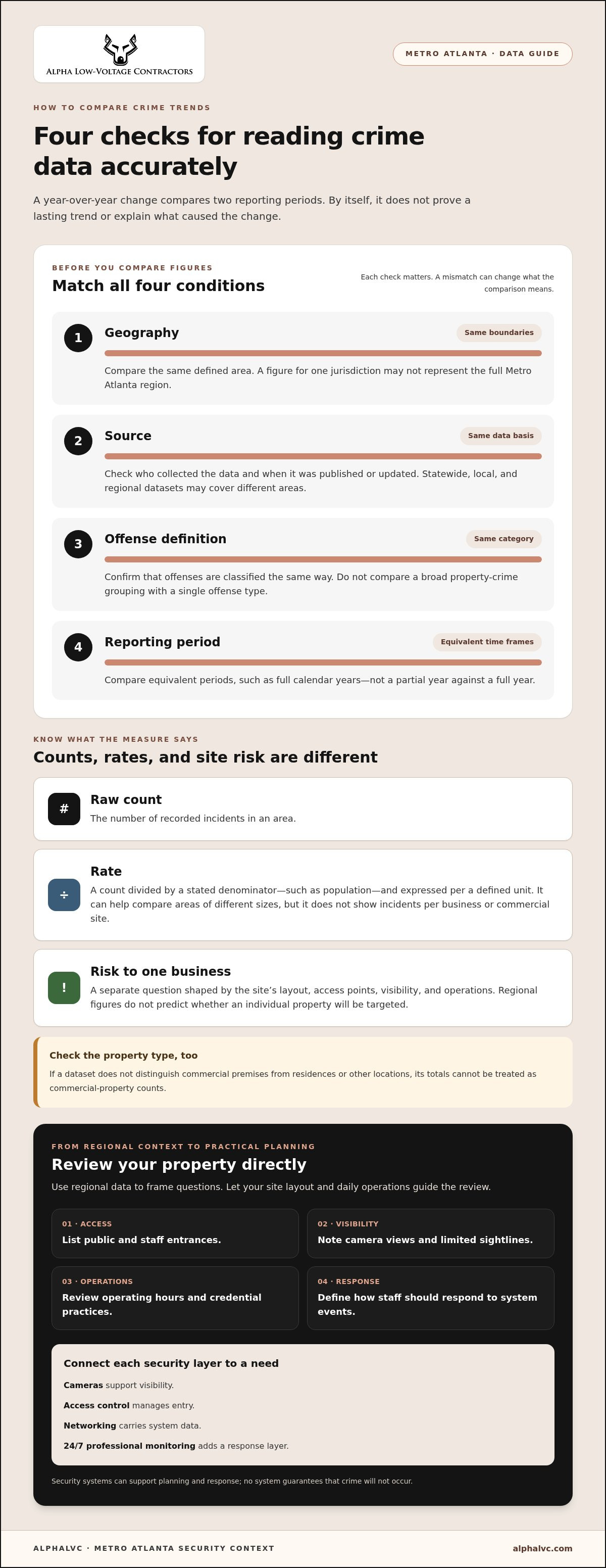
Before comparing figures, confirm that you’re looking at the same measure. A year-over-year percentage describes the change between two periods. By itself, it doesn’t establish a lasting pattern or explain what caused the change.
- 1. Match geography. Compare the same boundaries. A figure for one jurisdiction may not represent the full Metro Atlanta region.
- 2. Match the source. Check who collected the data and when it was published or updated. The Georgia crime statistics resource can offer statewide context, but its coverage may differ from local or regional datasets.
- 3. Match the offense definition. Confirm that categories are classified the same way in each period. Don’t compare a broad property-crime grouping with a single offense type.
- 4. Match the reporting period. Compare equivalent time frames, such as full calendar years, rather than a partial year against a full year.
Counts and rates answer different questions. A raw count gives the number of recorded incidents in an area. A rate divides that count by a stated denominator, such as population, and expresses the result per a defined unit. A population-based rate can help compare areas of different sizes, but it doesn’t show incidents per business or commercial site.
What can change in a year-over-year crime comparison?
“One year’s change is a comparison between two reporting periods, not proof of a lasting trend.” Reporting practices, population, or data coverage may also change, so review the definitions before drawing conclusions. For Atlanta commercial property crime rates, use consistent data as regional context, then assess your site directly. A site-specific security review can help connect that context to practical planning.
Turn Metro Atlanta Crime Context into a Site-Specific Business Security Plan
Regional crime information can help you frame security questions, but your property’s layout and daily operations should guide the plan. Review access points, sightlines, operating hours, and the areas your business needs to protect. This turns broad context, including Atlanta commercial property crime rates, into practical priorities for your Metro Atlanta location.
Start with the basics: list public and staff entrances, note where cameras need to capture clear views, review who has credentials, and define how staff should respond to system events. AlphaLVC’s Metro Atlanta security system installation guide and commercial surveillance camera guide offer additional planning details.
Which security measures should a business review first?
Start with entry points, camera coverage, credential practices, and event-response procedures. For areas where entry needs to be managed, commercial access control can help define who may enter. Cameras, access control, networking, and professional monitoring work as connected layers of a security stack. AlphaLVC provides professional installation and maintenance of security systems, surveillance cameras, and access control for businesses across Metro Atlanta. No system can guarantee that crime will not occur.
Connect each device to a specific need: cameras support visibility, access control manages entry, networking carries system data, and 24/7 professional monitoring adds a response layer. Industry benchmarks and local risk assessments can sit alongside your own site observations, not replace them. To explore a security system tailored to your Metro Atlanta property, visit AlphaLVC’s Metro Atlanta security systems.
Turn Crime Data into a Practical Security Plan
Atlanta commercial property crime rates provide regional context, not a prediction for your business. Compare figures only when geography, offense definitions, sources, and reporting periods align. Then focus on what you can assess directly: entrances, camera coverage, credential practices, and how your team responds to system events.
A site-specific plan can bring surveillance cameras, access control, networking, and 24/7 professional monitoring together as connected layers. AlphaLVC serves commercial clients across Metro Atlanta with professional installation and maintenance tailored to site needs. These measures support informed security planning, but they can’t guarantee crime prevention.
Discuss a site-specific security plan with AlphaLVC and take a practical next step toward a security system that fits your property.
Frequently Asked Questions
What are Atlanta commercial property crime rates?
Atlanta commercial property crime rates refer to recorded property-crime incidents or rates for a defined area and reporting period, not necessarily crimes at commercial sites alone. The specific offenses included depend on the dataset. Check its definitions, geography, dates, and rate denominator before interpreting a figure. Metro Atlanta data can provide context, but it isn’t a direct measure of risk to your business.
Are commercial property crime rates reported separately from residential crime?
Not always. Public incident data may record offense type and location without identifying whether a site is commercial or residential. Check the dataset’s fields and documentation before treating its totals as business-specific. If property type isn’t distinguished, use the figures as area-wide context rather than a count of crimes affecting commercial properties. A review of your site can help identify its security needs.
How can I compare Metro Atlanta property crime rates from year to year?
Use the same geographic boundaries, data source, offense definitions, and equivalent reporting periods for each year. Check whether figures are raw counts or rates. A rate divides incidents by a stated denominator, such as population, and expresses the result per a defined unit. Also review publication dates and dataset coverage, since updates or changes in reporting can affect comparisons.
Do Atlanta property crime rates predict the risk at my business?
No. Regional rates summarize recorded incidents across an area and period; they don’t account for your site’s layout, access points, visibility, or operating practices. Treat Metro Atlanta figures as context, then review your property directly. A site-specific security plan can consider surveillance cameras, access control, networking, and 24/7 professional monitoring as connected measures, without promising that any system will prevent crime.


