

What good is a restaurant camera system if it misses the details you need to review after an incident? Planning restaurant security cameras in Marietta GA means matching camera views to the way your restaurant operates. You need useful views of entrances, service areas, and exterior spaces, supported by reliable networking and footage you can review when needed. Cameras work best as part of a coordinated security stack, not as standalone devices.
This guide explains how to set coverage priorities, compare wired and wireless camera options, and plan structured cabling. You’ll also learn how cameras can connect with access control, alarms, and 24/7 professional monitoring. A site-specific plan for your Metro Atlanta restaurant can help address blind spots and make your security systems easier to manage.
Key Takeaways
- Map entrances, dining and point-of-sale areas, delivery access, storage corridors, and exterior spaces to set coverage priorities.
- For restaurant security cameras in Metro Atlanta, compare wired and wireless approaches based on cable routes, network design, and camera locations.
- Plan structured cabling as the network backbone for video and data, and decide how cameras should connect with access control, alarms, and monitoring.
- Use a site survey to guide camera placement, cabling, hardware design, installation, and testing with Metro Atlanta site conditions and local safety codes in mind.
Restaurant Security Cameras in Metro Atlanta: Identify the Coverage Your Site Needs
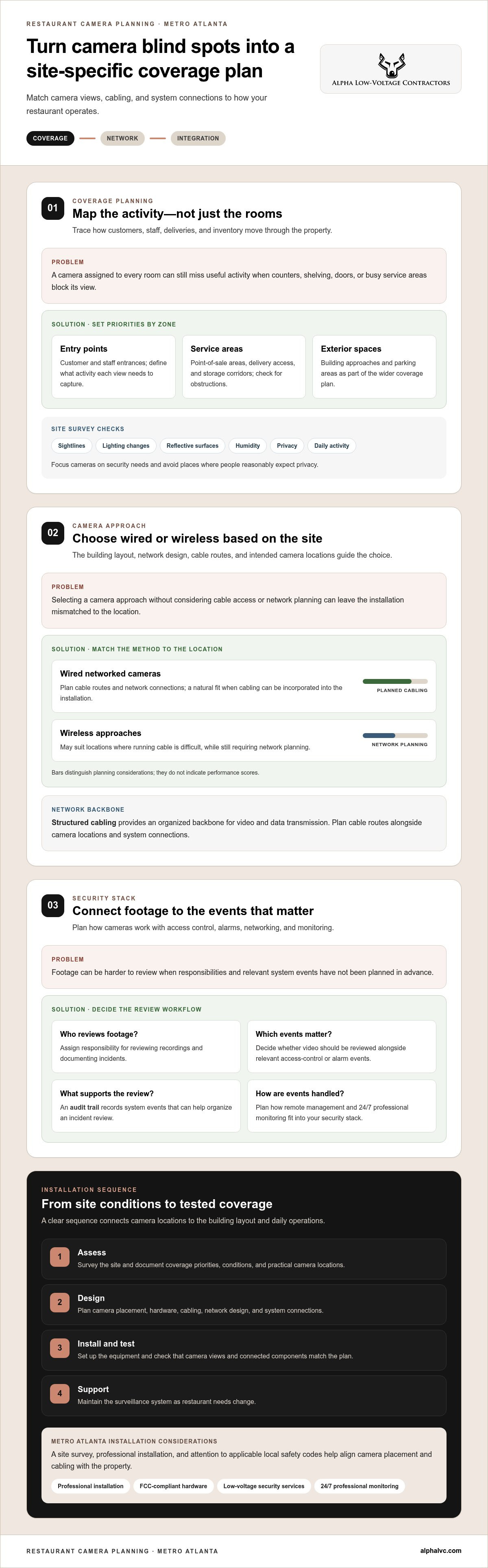
A restaurant camera plan should account for customer, staff, service, and exterior areas without leaving important activity out of view. Start by tracing how customers, employees, deliveries, and inventory move through the property. Entrances and dining areas help document activity in public spaces. Point-of-sale areas, delivery access, and storage corridors may call for different views based on how your team uses them.
Plan each camera around the view it needs to capture, rather than simply assigning one to every room. Counters, shelving, doors, and busy service areas can block sightlines. Window light and dim back-of-house areas can affect image quality at different times of day. Reflective surfaces may cause glare, and humidity in kitchens or other damp areas is a factor when choosing equipment locations. Protect privacy by focusing cameras on security needs and avoiding places where people reasonably expect privacy. For a basic overview of what is closed-circuit television (CCTV), see Wikipedia.
What does a restaurant camera site survey assess?
A site survey is an on-site assessment of entry points, vulnerable areas, and practical camera locations. It considers sightlines, lighting, reflective surfaces, humidity, privacy, the building layout, and daily activity. The survey helps turn those conditions into a coverage plan, so professional installation can place cameras to capture relevant activity rather than simply adding devices to a floor plan.
- Entrances: Identify customer and staff entry points, and consider what activity each camera view needs to capture.
- Service areas: Review point-of-sale areas, delivery access, and storage corridors, including obstructions that could limit a view.
- Exterior spaces: Consider building approaches and parking areas as part of the wider coverage plan.
For a Metro Atlanta restaurant, a site-specific assessment accounts for the property’s layout and operations. It gives you a practical basis for deciding which views matter, where cabling should run, and how surveillance fits into the wider security system.
Choose Restaurant Cameras That Fit Your Security Stack and Daily Operations
When planning restaurant security cameras Marietta GA, choose between wired networked cameras and wireless approaches based on the building, network design, and intended use. Wired cameras need planned cable routes and network connections, making them a natural fit when cabling can be incorporated into the installation. Wireless approaches may suit locations where running cable is difficult, but they still rely on network planning. A site survey helps match the approach to each location and the equipment the cameras need to connect with.
Structured cabling provides an organized network backbone for video and data transmission. Planning cable routes alongside camera locations helps coordinate surveillance with networking, access control, and alarms. The FTC's Start with Security guide also offers guidance on protecting business information, which is relevant when security devices connect to a network.
How should a restaurant evaluate camera and monitoring integration?
Before installation, decide who reviews footage, how staff document incidents, and which system events matter to your operation. For example, you may want to review video alongside relevant access-control or alarm events. An audit trail, a recorded history of system events, can help organize that review. Plan who is responsible for reviewing footage and responding to events, and how remote management and 24/7 professional monitoring fit into your security stack.
Professional installation brings cameras, cabling, and connected systems together in a planned setup. Learn more about AlphaLVC security solutions for restaurants and other businesses in Metro Atlanta.
Plan Professional Restaurant Camera Installation in Metro Atlanta
A well-planned installation follows a clear sequence: site survey, coverage plan, cabling and hardware design, professional installation, system testing, and ongoing support. For restaurant security cameras Marietta GA, this sequence connects camera locations to your building layout and daily operations. Testing should confirm that the camera views and connected equipment match the plan.
What should Metro Atlanta restaurant owners expect from professional installation?
Expect camera views to be planned around the restaurant layout, with cabling routes and connected systems considered as part of the design. Each camera should serve a defined purpose, and cabling should support the selected equipment and network design. Local expertise helps account for site conditions and applicable local safety codes, which can vary by property and installation.
AlphaLVC provides professional installation, FCC‑compliant hardware, and low-voltage security system services in Metro Atlanta. For more detail on the process, read our guides to professional surveillance camera installation in Metro Atlanta and security camera cabling guidance.
- Assess: Survey the site and document coverage priorities.
- Design: Plan camera placement, hardware, cabling, and system connections.
- Install and test: Set up the equipment, then check camera views and connected components.
- Support: Maintain the surveillance system as your needs change.
AlphaLVC installs and maintains surveillance cameras, integrates security systems, and provides 24/7 professional monitoring for Metro Atlanta businesses. Plan your restaurant camera installation with AlphaLVC.
Build a Camera Plan That Works for Your Restaurant
A useful restaurant camera plan starts with the activity you need to monitor, then matches camera views and cabling to your layout and daily operations. For restaurant security cameras Marietta GA, a site survey helps identify coverage priorities and shape the professional installation plan. Cameras are most effective as part of a coordinated security stack, with access control, alarms, networking, and monitoring considered together.
AlphaLVC provides professional installation and maintenance of commercial surveillance cameras, along with 24/7 professional monitoring and integrated security solutions. Metro Atlanta expertise, knowledge of local safety codes, FCC‑compliant hardware, and a low-voltage contractor license support a site-specific installation process.
Discuss restaurant security camera installation with AlphaLVC to plan coverage around your restaurant’s layout and operations.
Frequently Asked Questions
Can security cameras cover both a restaurant dining room and its entrances?
Yes. A camera system can be planned to cover dining areas and entrances, but the views depend on your layout, sightlines, lighting, and camera placement. A site survey maps useful views and identifies obstructions or changing light conditions. Don’t assume one camera can capture every space. Plan coverage around the activity and areas you need to see.
How should a restaurant choose between wired and wireless security cameras?
Base the choice on cable routes, network design, installation conditions, and restaurant operations. Wired networked cameras need planned cable routes and network connections. Wireless approaches may suit locations where running cable is difficult, but still require network planning. For restaurant security cameras Marietta GA, a site survey helps match the approach to the building and intended camera locations.
Can restaurant security cameras work with access control and professional monitoring?
Yes. Cameras can be planned as part of a security stack that includes access control, alarms, networking, and 24/7 professional monitoring. The system design should account for how the selected equipment works together. Decide which events matter to your restaurant and who will review footage or system activity as part of your response process.
What happens during professional restaurant camera installation?
Professional installation typically begins with a site assessment and coverage plan, followed by cabling and hardware planning, camera installation, system testing, and support. The approach depends on your building, camera locations, and connected security systems. AlphaLVC provides professional security installation for commercial clients in Metro Atlanta, coordinating the project around your site and operational needs.


