

Evaluating a Frontpoint security alternative in Georgia requires balancing hardware flexibility against recurring service fees. Choosing regional low-voltage services offers an effective route for Metro Atlanta sites needing custom hardware management. A tailored approach keeps your infrastructure aligned with local standards while delivering reliable coverage: you decide whether open hardware, hardwired runs, and portable monitoring matter more than a closed wireless kit.
Key Takeaways: Switching to local Georgia integrators provides hardwired reliability and open-hardware flexibility that national DIY brands cannot match for permanent commercial or residential properties.
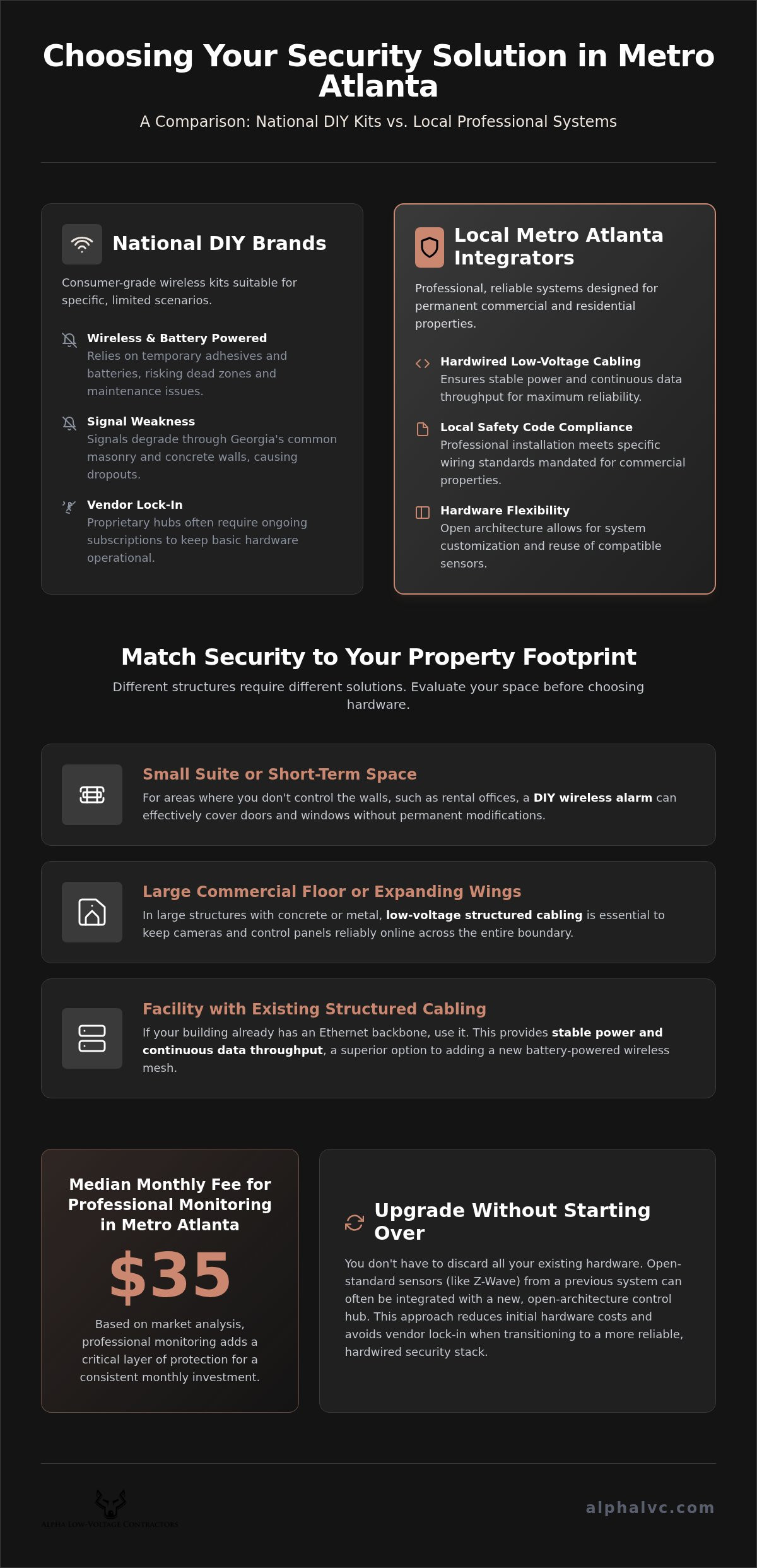
- Except when renting temporary spaces, adhesive-mounted wireless sensors often fail behind Georgia's masonry walls.
- Choose hardwired low-voltage cabling for commercial sites to ensure compliance with local safety codes.
- The article's market analysis shows a $35 median monthly fee for professional monitoring services.
Match security architecture to your Georgia property footprint
Evaluating a Frontpoint security alternative in Georgia starts with how your building is built, not with a product brochure. Before you compare panels, map your footprint to one of these common situations:
- Small suite or short-term space without existing infrastructure: a DIY wireless alarm can cover doors and windows when you do not control the walls.
- Large commercial floor with concrete or expanding wings: run low-voltage cabling so cameras and control panels stay online across the full boundary.
- Facility that already has structured cabling: use Ethernet connections for stable power and continuous throughput instead of adding another battery mesh.
Wireless setups struggle in large structures because building materials block signals. Hardwired access points keep network reliability intact as sites grow. You match hardware to physical space: DIY wireless alarms suit small spaces without existing infrastructure, while large sites need a full security stack (security system) to protect assets. Running low-voltage cabling supports cameras and control panels throughout commercial facilities. If your building already features structured cabling, Ethernet connections deliver stable power and continuous throughput.
Local safety codes mandate specific wiring standards for commercial properties across Metro Atlanta. Wireless signals degrade through heavy concrete walls, and hardwired systems prevent those dropouts. Partner with regional low-voltage specialists when you need a network built to those codes. Phone app control (remote management) gives teams access to system logs, and pairing hardwired devices with a monitoring service (cloud‑based management) supports immediate emergency response on larger boundaries. More on this: Metro Atlanta Alarms.
Tip: Evaluate if your facility has existing structured cabling before deciding on a DIY wireless setup.
Comparing Local Georgia Platforms to Frontpoint Hardware
Fee structure and physical connection type separate national DIY kits from local integrators long before you open the mobile app. Local security stack choices in Metro Atlanta emphasize physical reliability over adhesive-mounted consumer alarms. Based on eleven market samples, local monthly professional monitoring services typically range from twenty-five to fifty dollars per month, with a median of thirty-five dollars. Wireless consumer hardware often relies on temporary adhesives and battery power. Hardwired commercial installations use low‑voltage cabling to secure the building instead. You can review physical transmission line practice in this camera cabling guide. Hardwired setups protect against signal dropping when walls and equipment share the same floor plate.
| Feature Category | National DIY Brands | Local Metro Atlanta Integrators |
|---|---|---|
| Physical Connection | Wireless or battery | Hardwired low‑voltage cabling |
| Compliance Standards | Basic consumer grades | Local safety codes |
| System Control | Smartphone app only | Phone app control with local support |
Physical line connections prevent wireless signal interference on permanent business properties; DIY packages still suit temporary renters who cannot open walls. AlphaLVC designs systems to meet local safety codes across Metro Atlanta. Professional installation keeps cameras and sensors operational during power disruptions. Request a personalized quote for exact details on your facility.
Switch monitoring providers while keeping usable Frontpoint sensors
You can leave a closed hub without discarding every sensor you already paid for. Open-standard Z-Wave sensors work with new monitoring service platforms, yet proprietary hub panels usually block full secondary takeover.
Replacing proprietary control hubs with open architecture units reduces cost over time. Repurposing standard door or window contacts cuts initial hardware replacement spend. Older wireless sensors frequently lose signal when the main hub sits behind dense masonry; moving vital paths to a hardwired security system (security stack) removes those radio frequency drops across larger properties. Integrating retained sensors still requires verified FCC‑compliant hardware so any remaining wireless bridge stays stable.
Closed wireless ecosystems function like a toll road: subscription payments keep basic hardware operational. An un-slaved panel restores control over alarm components without vendor lock-in. For whole-home or whole-floor upgrades, use this local installation walkthrough for technical sequencing.
AlphaLVC installs flexible components across Metro Atlanta when you need that open layout. Hardwiring vital sensors remains the sound long-term path for facility protection. Ask for a sensor-by-sensor assessment if you want a clear reuse plan before you buy panels.
Transition from DIY wireless to hardwired infrastructure
Battery failures and radio dropouts show up after the install crew leaves; a planned cable plant prevents both. Replacing a proprietary wireless hub with a hardwired security system removes those failure modes across a commercial building.
Problem: battery-dependent sensors across a Metro Atlanta floor created recurring maintenance windows and dead zones whenever a pack failed behind a dense concrete partition.
Action: field crews replaced those sensors with low-voltage wiring and structured runs to the panel.
Outcome: system uptime stabilized because power and signal no longer relied on individual batteries or fragile radio paths.
Upgrading from basic consumer hardware to commercial infrastructure follows a clear physical and network sequence:
- Assess existing coverage: Run a site survey to identify vulnerable entry points, high-traffic corridors, and dead zones.
- Install structured cabling: Run low-voltage cabling like Cat6A through walls and ceilings to support continuous power and high-definition video transmission.
- Mount commercial hardware: Secure hardwired sensors and cameras that comply with local safety codes and support 24/7 Professional Monitoring.
- Integrate remote management: Connect hardware to a centralized platform for phone app control and automated access control logging.
A direct wired network gives property managers steady reliability; temporary wireless hubs still fit short-term residential spaces only. Use this system selection guide when you pick components. Professional installation by AlphaLVC aligns hardware with local safety codes and supplies dependable 24/7 Professional Monitoring on the finished plant.
Why all-wireless systems fall short of commercial requirements
Commercial floors share spectrum with tenant Wi-Fi, radios, and dense masonry, so an all-wireless alarm inherits that noise. Wireless commercial setups fail when radio frequency interference disrupts hardware communications. Operating a business in Metro Atlanta requires a security system that stays online during heavy network usage. Wireless signals suffer attenuation through dense concrete walls or interference from neighboring office networks.
Battery replacement cycles create maintenance gaps over time. Replacing batteries across dozens of sensors disrupts daily operations and risks dead zones if staff miss a cycle. Hardwired Cat6A structured cabling avoids those dropouts. Power over Ethernet delivers continuous operation and built-in network redundancy without individual batteries, which is why wired installations fit commercial properties that cannot pause for battery rounds. Dedicated line infrastructure also protects enterprise assets against signal jamming. Review dedicated low-voltage design options at AlphaLVC.
Pairing solid wiring with continuous monitoring service supports immediate response times during critical incidents. You control schedules and users through phone app control while physical lines carry basic connectivity. Build that plant through the project team when you are ready to scope cable routes. More on this: Metro Atlanta Alarms.
Integrate mobile app access with hardwired controls
Remote convenience only helps if the lock still answers when the radio path does not. Hardwired controllers deliver reliable physical security stack management across commercial properties. Hardwiring doors with structured cabling prevents signal loss from concrete walls or wireless interference. Integrating those panels with phone app control lets administrators manage physical locks alongside software platforms from anywhere.
Connecting physical doors directly to central servers simplifies credential management. You can review each entry event on an audit trail to spot unauthorized access or badge sharing. Adding AI-driven analytics to video streams helps flag unusual movement near primary access points.
Municipal safety regulations in Metro Atlanta mandate automatic release functions in crisis situations. Wireless hardware can drop connectivity during power events; hardwired systems remain responsive. Integrating mobile controls into low‑voltage cabling networks helps your system pass municipal inspections while keeping remote functions intact.
Local low-voltage installers keep the build aligned with building ordinances. The crew at AlphaLVC delivers clean panel layouts, full testing, and reliable hardware connections so uptime stays tied to copper, not to a single radio hop.
Tip: Verify that all edge equipment uses FCC-compliant hardware to prevent local signal degradation.
Frequently asked questions
What are the top 3 home security systems?
Wired security stack systems with local safety codes compliance, wireless self-installed platforms, and hybrid commercial access control setups lead the Metro Atlanta market. The overall market price band for subscriptions spans twenty-five to fifty dollars per month, with a median of thirty-five dollars based on eleven market samples from top providers. Rather than relying on off-the-shelf DIY kits, properties benefit from hardwired Cat6A structured cabling and low-voltage cabling installed by a licensed low-voltage contractor. You can compare customized layouts at AlphaLVC.
What matters most when I replace a DIY wireless kit?
Focus on open-standard sensors you can keep, a panel that does not lock you into one vendor, and hardwired paths through concrete or long corridors where radio already fails. Verify FCC‑compliant bridging for any wireless devices you retain, then prioritize structured cabling for cameras and life-safety points that must stay powered during an outage.
Can I install the system myself?
You can purchase self-installed wireless devices, but professional installation ensures your hardware meets strict local safety codes. DIY setups often suffer from weak wireless signals, incorrect camera placement, and missing audit trail data during critical incidents. Certified technicians execute a thorough site survey to place sensors correctly and run reliable structured cabling throughout your facility so the system operates without coverage gaps.
What monitoring service is included?
Your installation connects to 24/7 Professional Monitoring that verifies alarms and alerts local emergency dispatch immediately. This service checks hardware health, tracks badging events, and maintains an accurate audit trail for your property. Professional dispatch removes the delay of relying solely on phone app control notifications when you are away, so oversight continues while you are offline.
Securing Your Metro Atlanta Facility in 2026
Choosing a reliable Frontpoint security alternative in Georgia means weighing hardware flexibility against recurring service fees, then moving past simple wireless DIY kits when your floor plate, codes, or uptime targets demand enterprise-grade hardware.
AlphaLVC advisers deploy FCC-compliant hardware on structured cabling to raise uptime for commercial properties. The team integrates low-voltage cabling with professional installation to protect primary entry points and interior spaces. Your facility gains dependable protection through 24/7 Professional Monitoring, with fast response times and without wireless interference on the backbone. To evaluate physical vulnerabilities on site, schedule a professional survey at AlphaLVC Contact.


