

The cost of structured cabling services is driven by local safety codes, FCC‑compliant hardware, professional installation, and low‑voltage contractor licensing. AlphaLVC does not publish flat-rate figures because each commercial facility requires a site survey to determine accurate scope and hardware requirements. Contact AlphaLVC to schedule a professional assessment for your site.
Match Cable Media to Your Distance and Bandwidth Needs
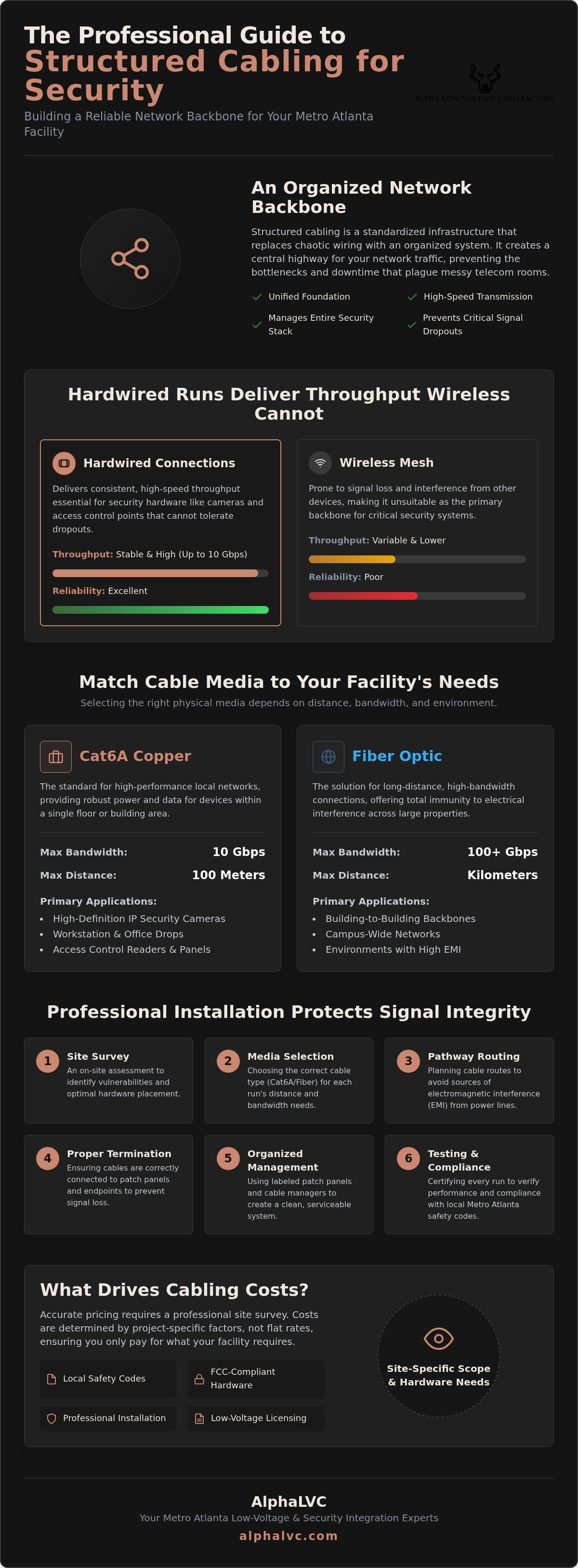
Before you pull a single run, pin down three decisions: how far the signal must travel, how much bandwidth your endpoints need, and what interference your pathways face. Typical situations we address with existing media options:
- Compact office floor with short workstation drops: copper horizontal cabling keeps cost and complexity in check for standard network traffic.
- High-definition security camera runs that also need power delivery: Cat6A supports 10 Gbps speeds and high power delivery over 100 meters, so your feeds stay stable across longer corridors.
- Campus backbone between distant buildings: fiber optic cabling (optic cabling) gives you immunity to electrical interference where copper would degrade.
Selecting the right physical media for your local facility depends on transmission distance, bandwidth requirements, and environmental conditions. With clients we see that selecting copper over fiber for extended runs leads to signal degradation. High-frequency video data requires dedicated bandwidth to prevent packet loss.
Cat6A handles 10 Gbps speeds and high power delivery over 100 meters, making it a strong fit for high-definition security feeds. For backbones connecting distant buildings, fiber optic cabling resists electrical interference that copper cannot shed on long paths.
Integrating proper wiring for security (low-voltage cabling) keeps performance steady across your system. For physical security planning, link your lines to security and access control.
Copper suits small footprints; optic lines suit multi-building campuses. Precise data cabling (structured cabling) designs that comply with local safety codes protect your enterprise hardware when the layout is surveyed before install day.
Structured Cabling Gives You an Organized Network Backbone
If your telecom rooms still look like a nest of unmarked jumpers, you already know why traffic stalls when a camera or door controller comes online. Structured cabling is a standardized building telecommunications infrastructure that uses organized point-to-point connections to carry data, voice, and video traffic.
This architecture divides a system into manageable subsystems, including entrance facilities, equipment rooms, and horizontal runs. Think of it as a central highway system for your network traffic; without organized lanes, gridlock follows.
This design provides a unified foundation for critical office hardware. It supports high-speed data transmission and links your security stack under one reliable layout.
When you install high-definition security hardware, proper network lines prevent lag and signal dropouts. Running high-bandwidth Cat6A wiring for security gives your hardware steady power and data delivery across long distances. You can learn more about choosing camera cables. More on this: Cabling for Security Cameras.
A hardwired network provides operational stability that wireless-only setups do not match under load. Technicians deliver full site surveys to design compliant systems across Metro Atlanta so you keep reliable operations day to day.
Hardwired Runs Deliver the Throughput Wireless Mesh Cannot
Bandwidth-heavy security hardware exposes weak pathways quickly, which is why organized data cabling matters before you add another dozen cameras. Organized runs remove data bottlenecks, giving your facility broad bandwidth and low packet loss. Hardwired connections outperform mesh-only wireless setups across commercial properties in Metro Atlanta, keeping throughput steady for security hardware that cannot tolerate dropouts. High-grade Cat6A runs deliver up to 10 Gbps speeds across your network backbone.
Poorly organized wiring for security causes signal attenuation that degrades camera feeds over time. Running unshielded lines next to fluorescent fixtures creates electromagnetic interference and digital artifacts on the picture. Certified technicians limit these performance drops by adhering to local safety codes during cable pathway routing.
Proper organization also speeds emergency troubleshooting. You can review network topology insights on the AlphaLVC Blog to see how clean patch panels shorten maintenance calls. Structured hardwired networks protect operational continuity when a single mislabeled jumper would otherwise cost you hours.
Cat6A and Fiber Serve Different Runs in Your Facility
Mixing the wrong media on a long backbone is a common reason IP camera networks stutter after move-in. Selecting the proper data cabling hardware helps your network meet technical standards and handle high bandwidth demands. In field work across commercial facilities, pairing Cat6A with high-density patch panels prevents unexpected network bottlenecks. Proper cable termination stabilizes continuous data flow for mission-critical hardware.
Cat6A copper handles high-speed data delivery over shorter distances, while fiber optic cabling sustains performance across long backbone links. Deploying hardwired cabling behind your office access control supports real-time event processing without signal interference. Hardwired backbones remain the dependable path for door controllers and related endpoints.
Choosing Cat6A fits localized office drops, whereas fiber suits multi-building links. Certified technicians handle professional installation to maintain compliance with local safety codes and FCC-compliant hardware guidelines across Metro Atlanta.
| Cable Type | Maximum Bandwidth | Primary Application |
|---|---|---|
| Cat6A | 10 Gbps | Local workstation drops and IP camera networks |
| Fiber Optic | 100+ Gbps | Building backbones and long-distance runs |
| Patch Panels | 10 Gbps (Cat6A rated) | Centralized rack management and cable termination |
Rigid Pathways Block Growth When Your Floor Plan Changes
Static conduits feel tidy on day one and expensive on the day you add a new wing of readers. Overly rigid network infrastructure halts operational growth during rapid expansion. Static physical layouts act like concrete pathways that prevent fast hardware moves. Installing rigid pathways without room for extra Cat6A lines is a mistake because modern facilities evolve constantly. Wiring for security needs built-in flexibility to handle changing hardware demands.
Data cabling must support new access control endpoints without forcing complete tear-outs. If your site plan ignores future bandwidth, simple office reconfigurations turn into costly overhauls.
Commercial facilities in Metro Atlanta need adaptable backbones that scale alongside modern cloud-based management platforms. AlphaLVC builds high-density drops that accommodate upcoming network shifts. Upfront planning protects your operational speed; reach out for a thorough review of your existing system.
Six Installation Steps That Protect Signal Integrity
A rushed pull sealed behind drywall is the kind of error you pay for twice. Executing a structured network deployment requires a systematic approach so signal integrity and safety hold up across your facility. During field deployments, proper sequence prevents cross-talk and reduces expensive troubleshooting after walls are sealed. Skipping systematic steps degrades network performance.
- Conduct site survey: Technicians inspect the Metro Atlanta building architecture to identify path obstacles and establish optimal hardware placement.
- Design cable pathways: Engineers map dedicated conduits, keeping wiring for security separate from high-voltage electrical lines to limit interference.
- Run lines: Installers pull Cat6A and fiber optic cabling through ceilings and walls using compliant support J-hooks.
- Terminate connections: Technicians wire modular jacks, patch panels, and hardware access points using precise pinout configurations.
- Test and certify: Field teams test every run with specialized tools to verify speed standards and bandwidth capacity.
Pathway design that separates data cabling from high-voltage power lines reduces electromagnetic interference on nearby runs. Treating network lines like standard electrical wire invites certification failures. Choosing a licensed installer ensures compliance with local safety codes and FCC-compliant hardware standards.
Tip: Always require certified test results for Cat6A and fiber optic runs before signing off on final installation. (Source: Standard Low-Voltage Industry Guidelines)
What Drives Cabling Cost and How SLAs Protect Uptime
Opaque labor assumptions are how a “simple re-cable” becomes a change-order stack. Clear project budgeting requires transparent labor parameters and predictable service level agreements for your network infrastructure. Cable run length, building architecture, and drop density drive installation expenses across Metro Atlanta facilities. Higher ceiling heights require specialized lifts, increasing labor hours. Upgrading to Cat6A wiring for security supports long-term transmission performance for data cabling drops.
From client work we see that scope creep frequently inflates initial network overhaul estimates: a facility arrives with an incomplete floor plan, pulls begin, then extra drops and pathway conflicts surface mid-job. Detailed site surveys remove those surprises before technicians begin pull tests, so the scope you approve matches the work on the walls.
Support commitments tie directly to response windows. Dedicated service level agreements protect operational uptime through guaranteed emergency response times. The team manages performance monitoring and physical hardware repairs under fixed agreements. For a figure that matches your floor plates and drop count, ask the technical team for a project-specific estimate through AlphaLVC.com.
How You Vet a Licensed Metro Atlanta Low-Voltage Contractor
A low bid means little if the installer cannot pass inspection on your property. Verify that low-voltage contractors hold a valid low-voltage contractor license and follow local safety codes in Metro Atlanta before signing any agreement.
You need verified technicians who understand local compliance standards. Unlicensed installations frequently lead to failed site inspections. Proper permits safeguard your enterprise network from legal liability.
Ask every candidate to show FCC-compliant hardware for all installed equipment. Confirm their team handles both data cabling and wiring for security under one roof; integrated deployments reduce systemic downtime.
Check whether the provider offers ongoing 24/7 professional monitoring alongside physical deployment. An experienced partner limits costly network misconfigurations. Verify credentials early on AlphaLVC.com, then schedule a site survey for your facility when you are ready to compare scoped proposals.
Frequently asked questions
What are structured cabling services?
Data cabling services provide an organized infrastructure of hardware and wiring for security to transmit video and network communications. These systems establish a reliable backbone for high-definition video transmission across commercial facilities. You can review your infrastructure needs at AlphaLVC.com.
What are the disadvantages of structured cabling?
The primary disadvantage is the initial labor required for physical installation and pathway planning throughout a facility. Higher material expenses for high-performance options like Cat6A also increase upfront deployment costs. Total expenses depend on your overall building layout; ask for a personalized quote for exact figures.
Is cabling a good career?
Installing network infrastructure offers a stable career path with strong regional demand for skilled technical professionals. Licensed technicians with low-voltage contractor license qualifications handle critical infrastructure installations for business security systems. You gain expertise in hardware alignment, network design, and safety compliance across diverse physical environments.
Do you install fiber optic cabling?
Yes, technical teams install specialized fiber optic cabling alongside standard copper networks for long-distance data connections. These glass lines deliver high throughput without electrical interference across expansive property layouts. Custom deployment options are available through AlphaLVC.com.
Are your technicians certified?
Technicians possess full trade licensing, professional certifications, and active local credentials for low-voltage installations in Metro Atlanta. Field teams comply with national safety codes and follow current EIA/TIA standards alongside BICSI standards. Professional oversight keeps your hardwired hardware aligned with continuous 24/7 professional monitoring networks.
Finalizing Your Network Foundation
The same questions that open this guide (which media fits your distances, how pathways will be surveyed, and who holds the low-voltage license) decide whether your 2026 upgrade holds under load. Upgrading your commercial facility requires dependable data cabling to support growing bandwidth demands. Certified wiring for security, continuous monitoring, and security stack integration can be tailored to your building layout. Hardwired infrastructure keeps surveillance cameras, physical access systems, and the local area network running without interruption when pathways, terminations, and tests follow a documented plan. Local expertise is how you meet strict safety standards without guessing at scope. To schedule a detailed site survey and request a custom scope proposal for your property, visit AlphaLVC Contact.


