

What if your cameras record a critical event, but infrared ghosting obscures the detail you need? A security system can appear to work while a camera, access-control device, or network connection is failing. If you’re comparing business security system maintenance plans Atlanta providers offer, look for checks of the full system, not just repairs after a problem appears.
A practical plan should spell out which equipment is inspected, how findings are documented, and what happens when a technician finds a fault. This guide explains what to ask about routine system checks, site surveys, cabling, camera performance, and changing access needs. For Metro Atlanta businesses, it also covers how to factor in local site conditions and confirm which safety requirements apply to your building.
Key Takeaways
- Compare business security system maintenance plans Atlanta providers offer by checking whether the plan reviews alarms, cameras, access control, and their connections together.
- Ask whether technicians inspect structured cabling and Cat6A connections, and how they check that connected devices are functioning as expected.
- Request a site survey when your layout, equipment placement, or security needs change. Software checks alone can’t identify every physical issue.
- Choose a provider familiar with Metro Atlanta sites, and ask how inspections account for conditions such as humidity and dust around outdoor equipment.
Evaluating Your Security Stack for Long-Term Reliability
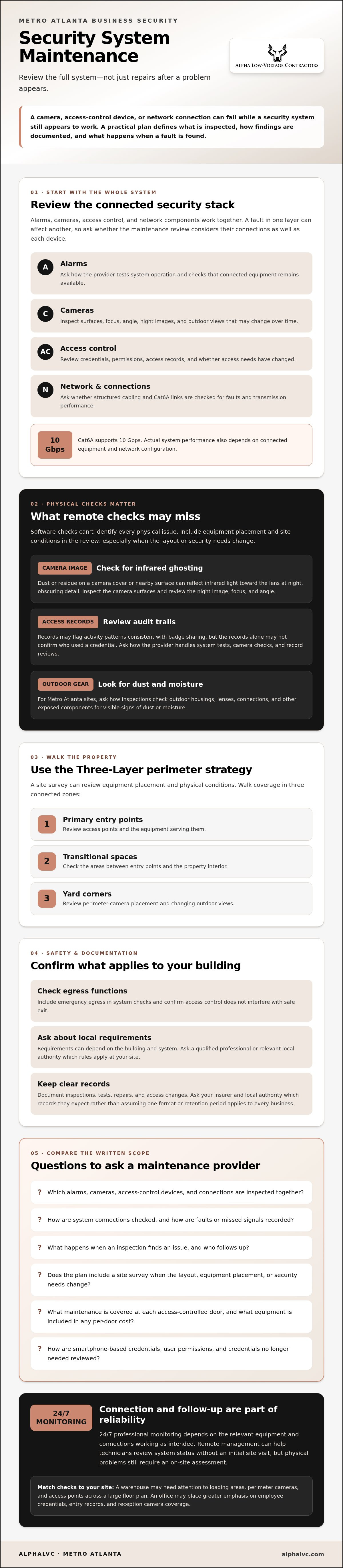
Your security stack is the connected set of alarms, surveillance cameras, access control, and network components that supports your facility’s security. A fault in one layer can affect others. A maintenance review should therefore consider how the system works as a whole, in keeping with the layered approach described in this overview of physical security measures.
Software updates can address supported software issues, but they won’t reveal a loose connection, an obstructed camera view, or a change to the property. A site survey gives a technician an opportunity to review equipment placement and physical conditions. For Metro Atlanta businesses, include outdoor cameras in checks for dust, moisture, and other visible conditions that could affect the equipment. Include commercial access control systems in the same maintenance review.
The Technical Risks of Reactive Maintenance
Waiting for a failure can leave image quality and access records unchecked. Dust or residue on a camera cover or nearby surface can reflect infrared light back toward the lens at night, creating infrared ghosting and obscuring detail. Inspect camera surfaces, check the night image, and review focus and angle. Outdoor camera views may also need attention when the surroundings change.
Review access-control audit trails for unusual credential activity. A record may flag patterns consistent with badge sharing, such as a credential appearing in unexpected activity, but the records alone may not confirm who used it. Ask providers how their maintenance process handles system tests, camera checks, and record reviews.
Key Components of Professional Maintenance Plans
A useful maintenance plan checks physical equipment and connections, not only software. Ask whether a technician tests structured cabling and Cat6A links for faults and transmission performance. Cat6A supports 10 Gbps, but actual system performance also depends on connected equipment and network configuration. Cabling checks can help identify issues that remote monitoring alone may not reveal.
Ask how the provider checks for radio frequency interference and confirms that installed devices are suitable for the system. For cloud-based management, review smartphone-based credentials, user permissions, and credentials that should be removed when access needs change. Include a physical walkthrough of the Three-Layer perimeter strategy: primary entry points, transitional spaces, and yard corners. The CISA physical security resources offer broader context for assessing protective measures across a property.
Adhering to Local Safety Codes in Metro Atlanta
Include checks of emergency egress functions, and confirm that access control does not interfere with safe exit. Requirements can depend on the building and system, so ask a qualified professional or relevant local authority which rules apply to your site. Keep records of inspections, tests, repairs, and access changes. Ask your insurer and local authority which records they expect instead of assuming one format or retention period applies to every business.
For code-related repairs, confirm that the contractor is qualified for the work and ask how the work will be documented. As you compare business security system maintenance plans Atlanta businesses may consider, review AlphaLVC’s security system services to learn about security support in Metro Atlanta.
Choosing business security system maintenance plans Atlanta providers offer
Choose a provider who can coordinate installation, maintenance, and monitoring across your security stack. 24/7 professional monitoring depends on the relevant equipment and connections working as intended. Ask how the provider checks that systems remain connected, how faults or missed signals are recorded, and who follows up when an inspection finds an issue. Compare the written scope of work, not just the plan name.
Local site conditions matter, too. In Metro Atlanta, ask how the provider inspects outdoor camera housings, lenses, connections, and other exposed components for signs of dust or moisture. When comparing proposals, request a site survey if your layout or equipment placement needs review, and ask what maintenance covers at each access-controlled door. If the cost per door for a wired, networked system is part of your budget, compare the equipment and maintenance included, not just the per-door figure.
Customizing Your Total Security Maintenance Strategy
A warehouse may need attention to loading areas, perimeter cameras, and access points across a large floor plan. An office may place greater emphasis on employee credentials, entry records, and camera coverage at reception. Ask the provider to tailor inspections to your layout and operating needs. Remote management can help technicians review system status without an initial site visit, though physical problems still require an on-site assessment.
Before choosing a plan, ask how maintenance findings are recorded and who is responsible for addressing them. AlphaLVC provides security systems, access control, surveillance cameras, and monitoring in Metro Atlanta. Review its security system maintenance service information as you compare plan details and provider responsibilities.
Set a Clear Maintenance Plan for the Year Ahead
A dependable security program involves more than responding when equipment fails. Look for a maintenance partner who can review your full security stack, check physical connections, and help keep system records organized. When comparing business security system maintenance plans Atlanta providers offer, confirm how inspections, monitoring, and follow-up fit your site and budget.
A site review can help identify what needs attention, from camera performance to access-control changes and network connections. AlphaLVC provides security systems, access control, surveillance cameras, and professional monitoring in Metro Atlanta.
Contact AlphaLVC to discuss your business security system needs and the installation, maintenance, and monitoring support available for your site.
Frequently Asked Questions
How often should my Metro Atlanta business security system be serviced?
Set the service interval with a qualified provider based on your equipment, site conditions, usage, and manufacturer guidance. When comparing business security system maintenance plans Atlanta companies offer, ask what routine visits include and what events call for an earlier inspection. Schedule a review after renovations, camera relocation, access changes, or repeated faults. Keep service records and track follow-up actions.
What is included in a professional security stack maintenance plan?
A professional plan should define which devices are tested, how results are recorded, and who handles identified issues. Ask whether the scope includes alarm signaling, camera image review, access-control permissions, network and structured cabling checks, and a site survey when your layout changes. Request a written list of exclusions, including replacement hardware, software subscriptions, and repairs outside scheduled inspections.
Do maintenance plans cover cloud-based management and software updates?
Sometimes, but don’t assume updates or cloud-based management reviews are included. Ask the provider to specify whether the plan covers software update checks, user permissions, smartphone-based credentials, and account access reviews. Confirm who approves updates, how potential service interruptions are handled, and whether these tasks are part of scheduled maintenance or require a separate request.
Why does my business need a qualified low-voltage contractor for maintenance?
Check the requirements that apply to the work and location with the relevant local authority, and verify that the contractor is qualified for the work in scope. Ask how repairs are documented and whether the contractor can address your system’s hardware, cabling, and access-control components while accounting for applicable local safety requirements.


