

Square footage alone cannot determine your commercial security needs. When property managers ask, "How many cameras do I need for my business across Metro Atlanta?", they often worry that pre-packaged retail kits will leave dangerous coverage gaps or strain network storage. You probably share those concerns, knowing that an arbitrary camera bundle rarely matches the actual layout of your doors, hallways, and exterior lots.
You can calculate the exact camera count your commercial facility requires by evaluating specific operational zones, ingress points, and high-risk assets rather than guessing by square feet. This guide walks through the exact zone-mapping formula, details critical placement locations from cash registers to back loading docks, and helps you prepare for a professional low-voltage site survey.
Key Takeaways
- Learn the zone-mapping formula that answers how many cameras do I need for my business by prioritizing perimeter access and interior risk zones over raw square footage.
- Review practical device baselines for Metro Atlanta retail shops, corporate offices, and industrial facilities to plan balanced security coverage.
- Evaluate how Cat6A structured cabling, switch bandwidth, and video retention schedules dictate your total supported camera streams.
- Prepare for an on-site low-voltage site survey to ensure your commercial camera layout complies with local safety codes and hardware standards.
Calculate Your Commercial Camera Count by Operational Zones
Relying on generic bundle packages leaves critical vulnerabilities uncovered. When deciding how many cameras do I need for my business, you must divide your facility into clear operational zones rather than buying a static four-pack. Modern Closed-circuit television (CCTV) design separates public access corridors from restricted back-of-house areas, assigning specialized lenses to distinct tasks.
Calculate your total camera count based on specific visual objectives:
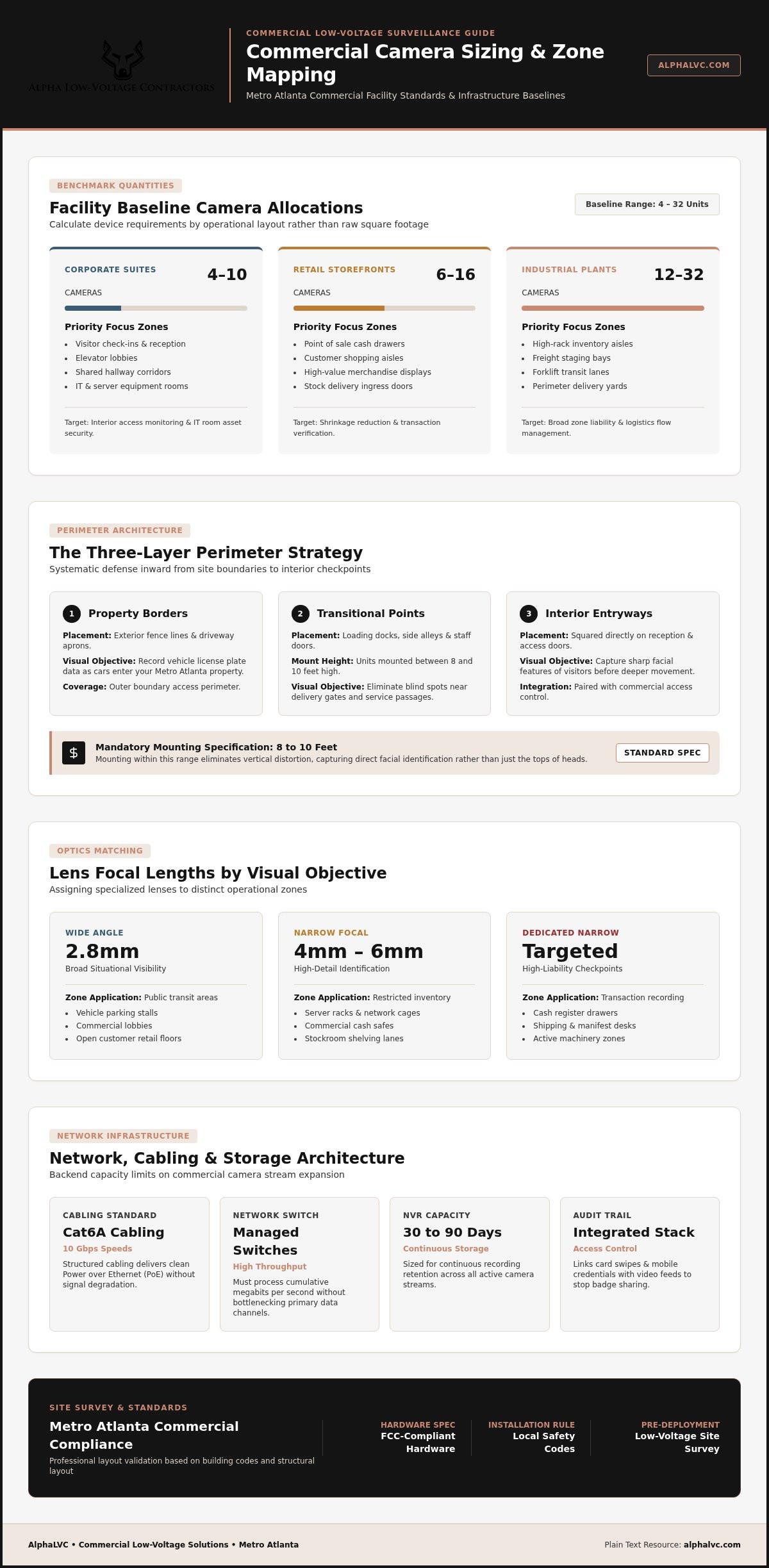
- Public transit areas: Wide-angle lenses (2.8mm) provide broad situational visibility across parking stalls, lobbies, and customer floors.
- Restricted inventory rooms: Narrow focal lenses (4mm to 6mm) capture high-detail identification at server racks, safes, and stockroom shelves.
- High-liability checkpoints: Dedicated narrow lenses target cash drawers, shipping desks, and machinery areas to record specific transactions clearly.
Applying the Three-Layer Perimeter Strategy to Building Entrances
Every commercial facility needs a structured approach to access security. The Three-Layer perimeter strategy secures your property from outer boundaries directly inward to interior rooms:
- Property borders: Exterior cameras positioned at fence lines and driveway aprons record vehicle license plate data as cars enter your Metro Atlanta property.
- Transitional points: Units mounted between 8 and 10 feet high monitor loading docks, side alleys, and employee entrances to eliminate blind spots near delivery gates.
- Interior entryways: Cameras focused squarely on reception doors capture facial features of visitors before they move deeper into the building.
Focusing on distinct zones instead of square footage gives you an accurate answer to how many cameras do I need for my business while keeping your budget targeted on true risk areas.
Average Camera Quantities for Retail, Office, and Industrial Spaces
Every commercial facility carries unique operational demands. If you are asking how many cameras do I need for my business, reviewing realistic industry baselines helps you establish an accurate starting budget:
- Retail locations (6 to 16 cameras): Retail storefronts prioritize points of sale, customer aisles, display fixtures, and stock delivery entries to combat inventory shrinkage.
- Corporate offices (4 to 10 cameras): Professional suites concentrate hardware at visitor check-ins, elevator lobbies, shared hallways, and IT equipment rooms.
- Industrial warehouses (12 to 32 cameras): Distribution plants demand broader coverage along high-rack aisles, staging bays, forklift lanes, and perimeter yards.
Eliminating Blind Spots Around High-Value Assets and Inventory
High ceilings and structural support pillars often obstruct wide-angle views. You can eliminate blind spots by staggering lenses to create overlapping fields of vision across aisles and inventory staging bays. Always mount your cameras between 8 and 10 feet high to achieve clear, unskewed facial identification angles rather than capturing just the tops of heads.
Physical surveillance works best alongside door security. When you integrate cameras with commercial access control systems, your system creates a visual audit trail whenever a worker uses keycards or mobile credentials at sensitive inventory doors. This integrated security stack stops badge sharing and confirms who accesses server rooms or cash offices.
Calculating how many cameras do I need for my business requires matching these equipment baselines to your physical structure. Scheduling an on-site evaluation with AlphaLVC ensures your facility design eliminates blind spots while meeting local safety codes across Metro Atlanta.
Network Bandwidth, Cabling, and Storage Limits on Camera Counts
Every camera stream you add places direct physical demands on your network infrastructure. Answering how many cameras do I need for my business requires reviewing your backend data capacity. High-resolution streams consume significant bandwidth, meaning unmanaged expansion will cause frame drops and recording failures across your facility.
Protect system performance by planning your network backbone alongside your hardware count:
- Structured cabling: Implement certified structured cabling for security cameras with Cat6A ethernet lines. This standard supports 10 Gbps transmission speeds and delivers clean Power over Ethernet without signal degradation.
- Switch throughput: Commercial managed switches must process cumulative megabits per second without bottlenecking primary data channels.
- Storage retention limits: Sizing network video recorders for 30 to 90 days of continuous recording requires massive storage, especially when deploying 4K resolution streams that generate large files.
Why a Professional Site Survey in Metro Atlanta Protects Your Investment
A professional site survey confirms physical mounting conditions before running a single drop. Certified low-voltage technicians inspect beam structures, drywall, drop-tile ceilings, and natural lighting shifts that induce infrared ghosting at night. Technicians verify cable pathways stay protected against environmental factors like warehouse humidity while ensuring full compliance with local safety codes and FCC standards.
Resolving how many cameras do I need for my business comes down to engineering rather than guesswork. Schedule an on-site consultation for commercial surveillance camera installation with AlphaLVC to verify network throughput and finalize your facility security design.
Build an Accurate Surveillance Plan for Your Facility
Determining how many cameras do I need for my business comes down to mapping physical operational zones, identifying structural blind spots, and supporting high-resolution streams with certified cabling. Pre-packaged retail kits don't give commercial facilities the coverage or network stability they require.
As a licensed low-voltage contractor serving Metro Atlanta, AlphaLVC delivers turnkey security solutions that integrate surveillance cameras, access control, and structured cabling. Our technicians ensure every deployment uses FCC-compliant hardware installed strictly according to local safety codes, protecting your property against blind spots and data bottlenecks.
Schedule a professional site survey with AlphaLVC to calculate the precise camera setup for your Metro Atlanta business and secure your facility with confidence.
Frequently Asked Questions
Can one wide-angle camera replace two standard commercial cameras?
A single wide-angle camera covers broad activity across open spaces, but it rarely replaces two narrow lenses for identification. Wide-angle views disperse pixel density across a larger visual field, reducing your ability to resolve faces or license plate details. For high-liability areas across Metro Atlanta properties, pairing dedicated directional cameras delivers far sharper visual evidence.
How many cameras can run on a single network switch?
Camera totals depend on the switch port capacity, Power over Ethernet budget, and data throughput. A standard 24-port PoE switch typically powers 16 to 20 commercial IP cameras while reserving bandwidth for uplink data and network routing. When calculating how many cameras do I need for my business, you must budget switch wattage so high-resolution streams don't lose power.
Does commercial building square footage alone determine my camera count?
No, square footage serves only as an initial baseline. Two facilities with identical 10,000-square-foot footprints demand completely different setups if one is an open storage floor and the other is a partitioned office suite. When determining how many cameras do I need for my business, prioritize physical entry doors, interior hallways, cash registers, and restricted inventory rooms over floor area.
Do I need interior cameras if my building perimeters are secured?
Yes, interior cameras provide essential commercial protection that exterior lenses cannot match. Exterior cameras secure outer walls, but they cannot track internal inventory movement, verify workplace safety incidents, or document server room access. Placing interior cameras along primary corridors and cash stations creates a reliable audit trail that verifies badge activity throughout your Metro Atlanta facility.


