

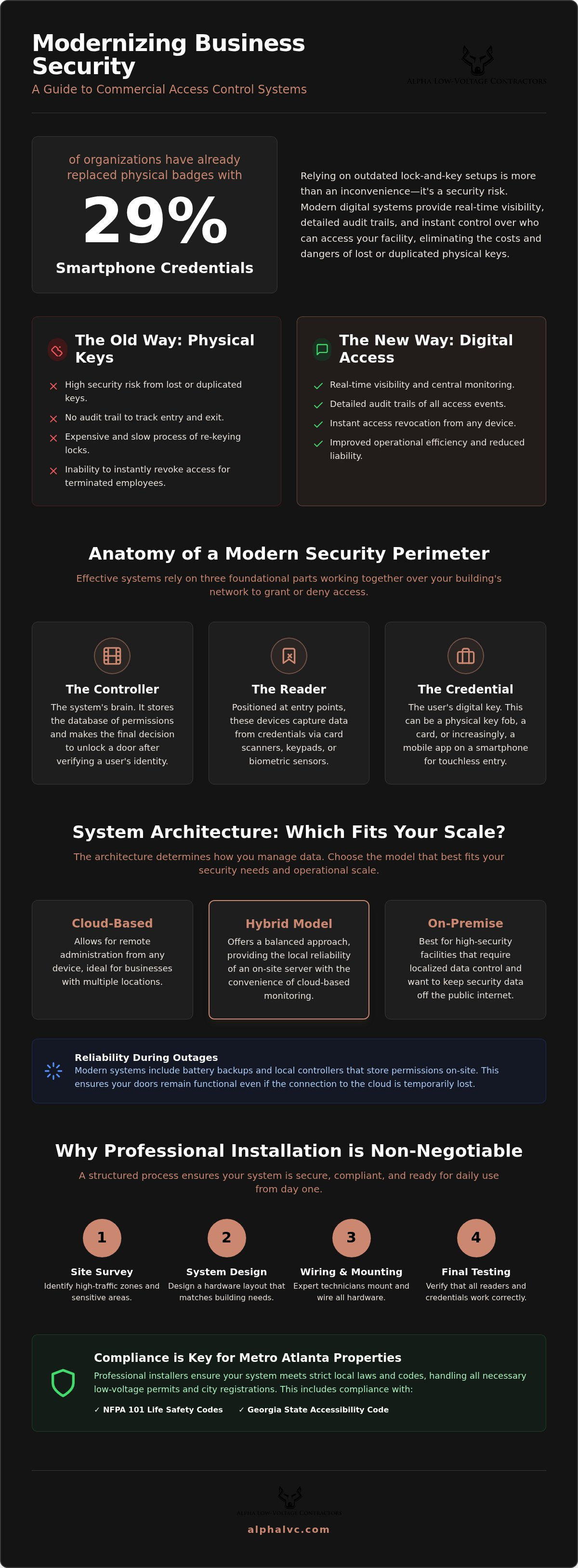
Did you know that 29% of organizations have already replaced physical badges with smartphone credentials? In a busy city like Atlanta, relying on outdated commercial access control systems isn't just an inconvenience; it's a security risk. You likely feel the frustration of re-keying locks when employees leave or searching for audit trails after a weekend incident. Managing security for a growing business should be a seamless experience, not a source of stress.
This guide explains how to protect your property using modern technology that provides real-time visibility. We will look at keyless entry, cloud-based management, and the specific regulatory requirements for Atlanta businesses as the city prepares for the 2026 World Cup. Discover how to build a scalable security framework that grows alongside your company and provides a better experience for your authorized staff.
Key Takeaways
- Understand why modern digital systems are replacing physical keys to provide real-time visibility and detailed audit trails for your facility.
- Compare the benefits of mobile-first credentials against traditional key fobs to find the best fit for your staff's entry experience.
- Learn how professional installation for commercial access control systems ensures your building meets strict Atlanta fire and electrical codes.
- Identify ways to integrate your security with existing network infrastructure to create a scalable system that grows with your business.
What are Commercial Access Control Systems and Why Do They Matter?
A modern access control strategy serves as the digital replacement for traditional lock-and-key setups. Instead of managing heavy key rings, commercial access control systems use electronic hardware and software to regulate entry. This technology eliminates the security risks associated with lost or duplicated physical keys. You gain precise, automated authority over every door in your facility.
The industry shift in 2026 prioritizes real-time visibility and detailed audit trails. Modern platforms allow you to monitor building activity from a central dashboard or mobile device. You can verify who entered a sensitive area after hours or revoke access for a former employee instantly. If you notice signs your business needs access control, such as a lack of tracking for visitor entries, upgrading to a digital system reduces liability and improves overall operational efficiency.
Key Components of a Modern Security Perimeter
Effective commercial access control systems rely on three foundational parts working together over your building's network.
- The Controller: This is the system's brain. It resides in a secure location and stores the database of permissions. It makes the final decision to unlock a door after verifying a user's identity.
- The Reader: These devices sit at entry points to capture data. Modern readers include high-frequency card scanners, encrypted keypads, or biometric sensors.
- The Credential: This is the digital key held by the user. While key fobs and cards remain common, many 2026 systems utilize mobile apps to provide a touchless entry experience.
To complement these digital components, many organizations also install physical barriers to control movement. For instance, Links Integrated Systems specializes in speed gates and automated barriers that work alongside these electronic systems to provide a robust physical and digital security presence for high-traffic facilities.
Evaluating Access Control Technology for Your Facility
Choosing the right hardware depends on your daily operations and long-term security goals. While traditional cards and fobs remain a standard choice, mobile-first credentials are gaining ground. Research shows that 29% of organizations are already using smartphone-based credentials for access. These systems let staff use smartphones for entry, which eliminates the ongoing expense of replacing lost physical keys. However, the most effective commercial access control systems often use a mix of both to accommodate different employee needs.
Reliability is often the biggest concern for business owners during a power or internet outage. Modern commercial access control systems include battery backups and local processing to handle these exact scenarios. High-quality installations include local controllers that store permissions on-site. This ensures your doors remain functional even if the connection to the cloud is lost. For companies growing across Metro Atlanta, scalability is equally important. You'll want a system that lets you add new entry points easily as your footprint expands. If you're unsure which hardware fits your building, you can consult with a local specialist to review your specific layout.
Cloud-Based vs. On-Premise: Which Fits Your Scale?
The architecture of your system determines how you manage data and user permissions. Cloud-based systems are ideal for businesses with multiple locations because they allow for remote administrative access from any device. On-premise systems are better suited for high-security facilities that require localized data control and don't want their security data on the public internet. Hybrid models offer a balanced approach, providing the local reliability of a physical server with the modern convenience of cloud-based monitoring features.
Professional Installation: Securing Your Metro Atlanta Property
Installing commercial access control systems requires a methodical approach to ensure every entry point is secure. The process begins with a detailed site survey to identify high-traffic zones and sensitive areas. Next, expert technicians design a hardware layout that matches your specific building needs. After the hardware is mounted and wired, the team conducts final testing to verify that credentials work correctly. This structured process ensures your system is ready for daily use from day one. You can find more details in our 2026 Buying Guide for professional security installation.
Professional installation of commercial access control systems ensures your business stays compliant with local laws. DIY attempts often fail because commercial properties must follow strict electrical and fire codes. In Metro Atlanta, systems must comply with NFPA 101 Life Safety Codes and the Georgia State Accessibility Code. Professional installers handle the necessary low-voltage permits and city registrations required for legal operation. Beyond the physical setup, 24/7 professional monitoring provides a critical layer of safety. It ensures that security incidents receive an immediate response, even when your building is empty.
Integrating Access Control with Surveillance and Networks
A professional network setup is the foundation of any secure commercial facility. We use high-quality structured cabling to ensure system uptime and fast data speeds between readers and controllers. When you integrate surveillance cameras, you gain visual verification for every access event. This allows you to see exactly who used a credential at a specific time. This combination of data and video creates a comprehensive security environment that protects your business assets. For organizations looking to extend this level of precision to their broader industrial infrastructure, specialists like anadigi.co.za offer expertise in automation and energy optimization.
Securing Your Atlanta Business for the Future
Managing a facility in a growing city requires a focus on reliability and precision. By transitioning to digital credentials, you gain real-time visibility that traditional keys simply cannot provide. Professional installation ensures your hardware meets local fire codes while integrating seamlessly with your existing network infrastructure. These commercial access control systems are the foundation of a modern, scalable security strategy.
AlphaLVC brings local Metro Atlanta expertise to every project. We are integrated network and security specialists who prioritize your building's uptime. Our team provides 24/7 professional monitoring to ensure your property is protected around the clock. Ready to upgrade your facility's protection? You can Request a Professional Security Assessment from AlphaLVC to see how we can secure your property. Protecting your business is a continuous process, and the right partner makes it easy to stay ahead of evolving threats.
Frequently Asked Questions
What is the average cost of a commercial access control system in 2026?
The total investment for commercial access control systems depends on the number of entry points and the specific hardware you choose. Factors such as software licensing, credential types, and the complexity of your building's wiring will influence the final cost. Every facility has unique requirements, so a detailed site survey is necessary to determine the specific labor and equipment needed for your property.
Can I integrate my existing security cameras with a new access control system?
You can typically integrate existing surveillance cameras if they follow standard network protocols. Modern security platforms allow you to link video footage directly to entry events in your activity log. This integration provides a visual record of every person who uses a credential, which helps verify identities and improves your overall security oversight.
How long does it take to install access control for a mid-sized Atlanta office?
A standard installation for a mid-sized office usually takes between three and five business days to complete. This timeline includes mounting hardware, configuring the network, and performing final system testing. Larger projects or facilities that require extensive new structured cabling for commercial access control systems may require additional time to ensure everything meets local building codes.
What happens to the access control system if the power goes out?
Your system will remain operational during a power failure if it includes a dedicated battery backup. Professional installations use local controllers that store permissions on-site, so doors continue to function even if the internet connection is lost. Most systems also utilize fail-safe hardware to ensure that employees can always exit the building safely during an emergency.


