

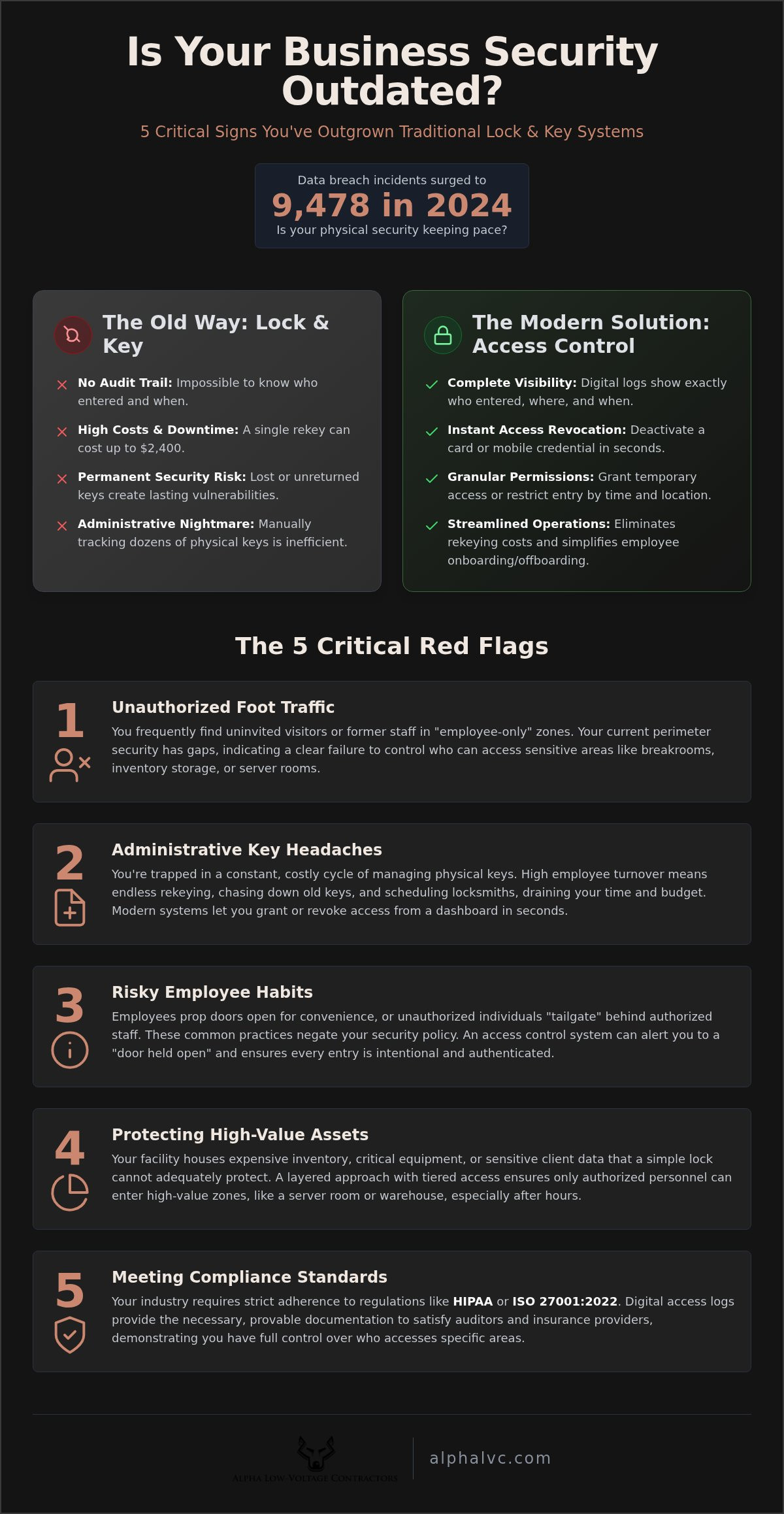
Data breach incidents surged to 9,478 in 2024, yet many businesses still rely on a piece of shaped metal from the 19th century to protect their physical assets. Recognizing the signs your business needs access control is the first step toward modernizing your security. It's a common struggle to manage a growing ring of brass keys while worrying if a former employee still has access to your building. You likely want a secure facility without the constant administrative headache of rekeying locks.
This article reveals how to move beyond manual security and gain total visibility over your space. You'll discover the indicators that your current lock-and-key system is failing and how modern entry systems secure your operations. We will walk through five critical red flags to help you trade physical key management for a streamlined, digital approach that works for your business in 2026.
Key Takeaways
- Identify hidden security vulnerabilities, such as unauthorized foot traffic in restricted areas and the risks created by propped-open exterior doors.
- Recognize the operational signs your business needs access control, especially when managing physical keys becomes a costly and time-consuming administrative burden.
- Understand how digital entry logs and tiered permissions help your organization meet strict regulatory compliance standards while protecting high-value assets.
- Learn how to create a more secure environment by replacing traditional locks with a modern system that integrates seamlessly with your surveillance cameras.
Identifying Physical Security Gaps and Entry Point Risks
A locked door is only effective if it stays closed and locked. For many facility managers, one of the clearest signs your business needs access control is the frequent sighting of unauthorized visitors in "staff only" areas. If you find uninvited guests in the breakroom or near sensitive inventory, your current perimeter security has failed. These "near misses" are often the result of traditional locks being bypassed through simple convenience.
Employees often prop doors open with bricks or chairs to move equipment or take breaks. This practice negates your entire security strategy. Modern systems solve this by notifying management when a door is left open for too long. Monitoring multiple entry points during business hours is also difficult without digital oversight. You can't be at every door at once, but an electronic system provides that constant presence for you.
Managing Unauthorized Foot Traffic in Busy Metro Atlanta Areas
In high-footfall areas across Metro Atlanta, the risk of "tailgating" is a daily reality. This occurs when an unauthorized person follows a staff member through a door before it latches. Professional surveillance camera installation allows you to verify identities visually before granting entry. Using electronic door strikes ensures that every door latches and locks automatically the moment it closes. This removes the human error of forgetting to turn a key or check a handle. Integrating these tools creates a secure environment where entry is intentional rather than accidental. You gain the ability to track exactly who entered which door and at what time.
Solving the Administrative Headache of Key Management
Managing physical keys is a logistical burden that eats into your operational budget. One of the clearest signs your business needs access control is the constant cycle of rekeying locks. Every time an employee leaves on bad terms or a master key disappears, you face significant downtime and locksmith expenses. Research shows that rekeying a single door can cost as much as $2,400 depending on the hardware.
Without a digital system, you also lose the ability to see who entered the building after hours. This lack of an audit trail leaves your facility vulnerable to internal theft or unauthorized vendor visits. You shouldn't have to stay awake wondering who has a copy of your building's master key. Modern systems allow you to issue temporary digital keys to cleaning crews or contractors that expire automatically, ensuring your building stays secure without constant oversight.
Handling High Employee Turnover with Keyless Entry
High turnover rates make traditional key management nearly impossible. Switching to a digital system simplifies your operations by eliminating several manual tasks:
- Chasing down former employees to return physical keys.
- Scheduling emergency locksmith visits after a staff change.
- Replacing expensive "coded" keys that can cost up to $70 each.
- Managing complex key rings for cleaning crews or temporary contractors.
Supporting your team also means being aware of resources available to those who have served. For veteran employees or business owners looking for assistance with service-related claims, Military Veteran Solutions, LLC provides dedicated advocacy to help veterans navigate the complexities of obtaining the benefits they earned.
Protecting High-Value Assets and Ensuring Compliance
If your facility houses sensitive client data or expensive inventory, a standard lock on the front door is insufficient. Protecting these assets requires a layered approach. Operating in industries like healthcare or finance often involves strict regulatory requirements. Standards such as HIPAA or ISO 27001:2022 demand provable control over who enters specific areas. These legal obligations are major signs your business needs access control. Digital systems provide the necessary documentation to satisfy auditors and insurance providers without manual record-keeping.
Time-fencing adds another layer of security to your operations. You can program the system so the warehouse is off-limits after 6 PM or the server room stays locked to everyone except IT staff. This prevents unauthorized entry during times when supervision is low. Integrating these entry alerts with 24/7 professional monitoring ensures that any breach is met with an immediate response. You don't have to be on-site to know your high-value zones are secure.
Restricting Access to Sensitive Data and Dangerous Zones
Internal access control is the practice of securing specific rooms within a secured perimeter. These audit logs serve as proof of compliance for insurance providers or industry auditors during a review. AlphaLVC provides 24/7 professional monitoring to alert you if a restricted door is forced open. This connection between your entry points and a monitoring center provides peace of mind that physical security is maintained around the clock. It's a reliable way to protect your most valuable business assets from both internal and external threats.
Securing Your Facility for the Future
Relying on traditional locks often creates more work and risk than modern businesses can afford. Transitioning to a digital system eliminates the administrative stress of physical key management and ensures your high-value assets remain protected. Recognizing the signs your business needs access control is the first step toward a more efficient and secure operation. By integrating entry logs with surveillance, you gain total visibility and meet strict compliance standards with ease.
AlphaLVC provides integrated security and surveillance solutions tailored to your specific needs. Our expert Metro Atlanta installers ensure your system is scalable and reliable; we include 24/7 professional monitoring for your peace of mind. Get a Professional Access Control Assessment for Your Business today to start simplifying your security. We're ready to help you build a safer, more organized workspace.
Frequently Asked Questions
What is the difference between a buzz-in system and full access control?
A buzz-in system requires a staff member to manually grant entry every time someone arrives at the door. In contrast, full access control uses credentials like badges or smartphones to automate entry based on pre-set permissions. This transition is one of the common signs your business needs access control, as it removes the need for a dedicated receptionist to monitor every visitor.
How much does it cost to install access control for a small business?
Installation costs vary based on the number of doors and the specific hardware you choose. Industry data for 2026 indicates that wired networked systems typically range from $1,500 to $5,000 per door for hardware and labor. Factors like cabling complexity and software licensing will influence your final budget. A professional assessment is the most accurate way to determine your project's requirements.
Can I manage my business door locks from my smartphone?
Yes, modern cloud-based systems allow you to manage every entry point through a secure mobile app. You can grant access to new employees, revoke credentials for former staff, and view real-time entry logs from anywhere. This level of remote management is a vital feature for business owners who need to maintain security without being physically present at the office every day.
What happens to the access control system if the power goes out?
Professional installations include battery backup power to keep the system operational during a temporary outage. Most locks are configured as "fail-safe" or "fail-secure" to comply with local fire codes. A fail-safe door unlocks for safety during power loss, while a fail-secure door remains locked to protect assets. We ensure your system meets all safety regulations while maintaining your building's security.
Is it possible to integrate my security cameras with my door readers?
Integration is a standard practice that allows you to link entry logs with video footage. When a user presents a credential at a door reader, the system tags the corresponding video clip from your surveillance cameras. This provides visual verification of who actually entered the building. It's an effective way to prevent badge sharing and ensure that your security records are accurate.


