

The best surveillance cameras for business aren’t automatically the ones with the highest resolution. A camera needs to capture the right details in the area you want to monitor and fit your network and daily operations. If you’re comparing options for a Metro Atlanta property, consider coverage, installation, recording, and ongoing support before choosing equipment.
This 2026 buyer’s guide explains how to compare camera capabilities by location, image needs, and network requirements. Learn how a site assessment can inform camera placement, why structured cabling and professional installation matter, and what to ask about system management and maintenance. We’ll also cover how cameras may fit into a broader security setup with access control and 24/7 professional monitoring, when those services suit your needs. The goal is to help you judge proposals by how well the full system supports your business, not by a camera specification alone.
Key Takeaways
- Match the best surveillance cameras for business to the areas you need to observe and the details you may need to identify.
- Compare image detail, field of view, low-light performance, recording needs, and management requirements before selecting cameras.
- Check how network design and structured cabling will support video transmission across your property.
- For a Metro Atlanta property, document your risks, request a site review, compare system plans, and clarify ongoing support before moving forward.
How to define the best surveillance cameras for your business
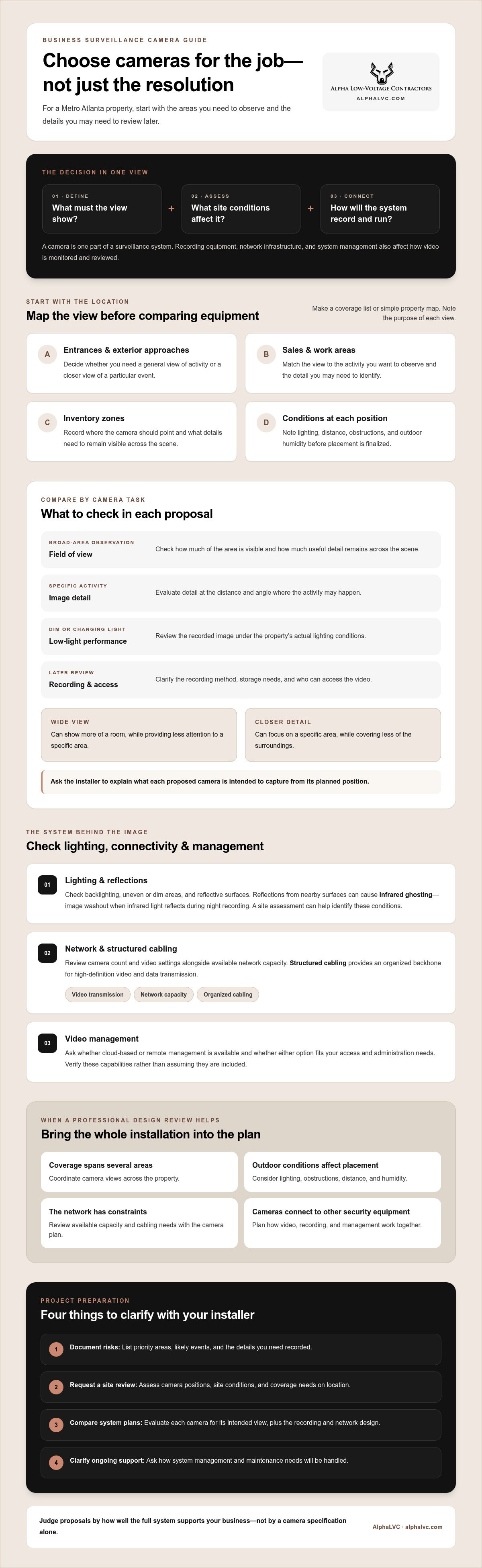
The right camera depends on your property, business activity, and the details you may need to review later. A camera meant to observe a broad area has different priorities from one aimed at capturing activity at a doorway or checkout. A wider view can show more of a space, while a tighter view can give more attention to a specific area. Neither guarantees a usable image in every condition, so decide what each camera needs to show before comparing equipment.
A surveillance system is more than its cameras. Recording equipment, network infrastructure, and system management all affect how video is monitored and reviewed. That is the practical context for Closed-circuit television (CCTV): connected components support video monitoring, recording, and review.
Which business areas and events should cameras cover?
Start with a coverage list or a simple property map. Mark entrances, sales or work areas, inventory zones, and exterior approaches. For each location, note whether you need a general view of activity or a closer view of a particular event. Also record conditions that could affect camera placement or the recorded image:
- Lighting: Note bright backlighting, uneven lighting, and areas that become dim.
- Distance and obstructions: Record how far the subject is from the camera and identify anything that could block the view.
- Humidity: Consider moisture conditions when planning outdoor camera placement.
These notes help you compare the best surveillance cameras for business according to the task each camera must perform, rather than choosing by one specification. For installation considerations, see the professional camera installation guide. A site review can help connect your coverage list to camera placement at a Metro Atlanta property.
Which business camera features should you compare before choosing?
First define the job each camera view needs to do. Then check how the complete system will record, store, and manage its video. The best surveillance cameras for business are selected for the property, not chosen from a universal ranking. Image detail, field of view, low-light performance, recording needs, and management options all matter.
How do lighting, connectivity, and video management affect the choice?
Review low-light conditions at the property, including reflective surfaces that can cause infrared ghosting, or image washout when infrared light reflects off nearby surfaces. A site assessment can help identify these conditions before camera placement is finalized.
Network design matters too. Consider camera count and video settings alongside available network capacity. Structured cabling provides an organized backbone for high-definition video and data transmission. Review the security camera cabling guidance as you assess connection needs.
Ask whether cloud-based or remote management is available and whether either option suits your access and administration needs. Treat these as questions to verify, not features to assume. For help discussing camera, network, and management needs at your Metro Atlanta property, contact AlphaLVC about security systems.
When should you choose professional camera design and installation in Metro Atlanta?
Professional camera design can be useful when coverage spans several areas, outdoor conditions affect placement, the network has constraints, or cameras need to work alongside other security equipment. The best surveillance cameras for business depend on how cameras, cabling, recording, and management will work together. Prepare for a project with these steps:
- Document risks: List priority areas, likely events, and the details you need recorded.
- Request a site review: Ask for an on-site assessment of camera views, lighting, obstructions, and network conditions.
- Compare system plans: Review proposed camera locations, low-voltage cabling, network connections, recording, and management.
- Clarify support: Ask what maintenance is included and how system issues will be handled.
What should a business ask a Metro Atlanta camera installer?
Ask how the site review will assess camera views, lighting, recording needs, network capacity, and maintenance. If access control or 24/7 professional monitoring is a priority, ask how those services could fit into the proposed security stack. For organizations aiming to protect connected devices and manage traffic across their infrastructure, discover Lionic to explore advanced network security and application control technologies. Confirm which system management options are included and what ongoing support covers.
For planning beyond installation, review this security system maintenance guidance. If you’re evaluating a camera project in Metro Atlanta, contact AlphaLVC to discuss your security system needs.
Plan a Camera System Around Your Business
The best surveillance cameras for business are selected to meet your property’s coverage needs, image requirements, and network capacity. Compare proposals by how cameras, recording, cabling, and management work together, then review the maintenance and support included.
For a Metro Atlanta business, professional installation can help coordinate surveillance cameras with integrated network capabilities. AlphaLVC provides professional camera installation and maintenance, with 24/7 professional monitoring available as part of its security offerings.
Ready to discuss a system that fits your site and operations? Discuss a business camera system with AlphaLVC. Start with your priority areas and the details you need each camera to capture.
Frequently Asked Questions
How do I choose the best surveillance cameras for my business?
Choose cameras based on the areas and events you need to observe, not a generic ranking. Compare image detail, field of view, lighting performance, recording options, network requirements, and management needs. For a complex property, request a site review to assess camera views and site conditions. The best surveillance cameras for business are those specified for your actual coverage and evidence needs.
Are wired or wireless surveillance cameras better for a business?
Neither option is best for every business. The right choice depends on your building layout, network design, camera locations, and reliability requirements. Structured cabling may suit a planned commercial system, but installation constraints and system needs should guide the decision. Ask a professional to review how cameras will connect, how video will be managed, and whether the proposed setup fits your property.
Neither option is best for every business. The right choice depends on your building layout, network design, camera locations, and reliability requirements. Structured cabling may suit a planned commercial system, but installation constraints and system needs should guide the decision. For complex commercial spaces requiring coordinated low-voltage infrastructure, teams like AV design engineering consultants Los Angeles provide ICT and system planning to ensure wiring supports both security and multimedia networks. Ask a professional to review how cameras will connect, how video will be managed, and whether the proposed setup fits your property.
Can business surveillance cameras capture license plates?
They may capture readable license plate details if the camera’s verified capabilities and placement suit the intended view. Viewing angle, distance, lighting, and site conditions can affect the recorded image. Don’t assume ordinary footage will identify a plate. During a professional assessment, explain where vehicles approach or pass and ask whether the proposed camera and placement suit that coverage need.
How much does it cost to install business surveillance cameras?
Project pricing depends on scope, including camera count and locations, cabling, network requirements, recording, and integration needs. Request a proposal based on your property and coverage plan rather than relying on a general estimate. Ask the provider to separate equipment, installation, and any ongoing services so you can compare what each proposal includes for your Metro Atlanta business.


