

What if your high-end security system is actually leaving your property vulnerable because of a single six-inch blind spot? You've likely invested in quality hardware to gain peace of mind. However, the fear of a missed angle or a legal misstep can make any property owner second-guess their setup. It's common to feel uncertain about exactly how many cameras are necessary to be effective. By mastering these expert security camera placement tips, you'll eliminate coverage gaps and ensure your metro Atlanta property remains secure. This guide provides a clear map for your surveillance layout and explains the legal requirements for recording on your premises. We also explore how professional monitoring from alphalvc.com provides the steady assurance of an expert team watching over your investment. Visit alphalvc.com to see how to transform a passive system into a 24/7 shield.
Key Takeaways
- Learn why mounting cameras between 8 and 10 feet provides the ideal balance between capturing facial detail and protecting hardware from tampering.
- Apply expert security camera placement tips to high-traffic zones like front entrances and driveways to effectively record license plates and package deliveries.
- Discover how to identify and fix common technical obstacles like sun glare while ensuring your surveillance layout respects Georgia privacy regulations.
- Understand the benefit of connecting your strategically placed system to 24/7 professional monitoring services available at alphalvc.com.
Fundamental Principles of Security Camera Placement
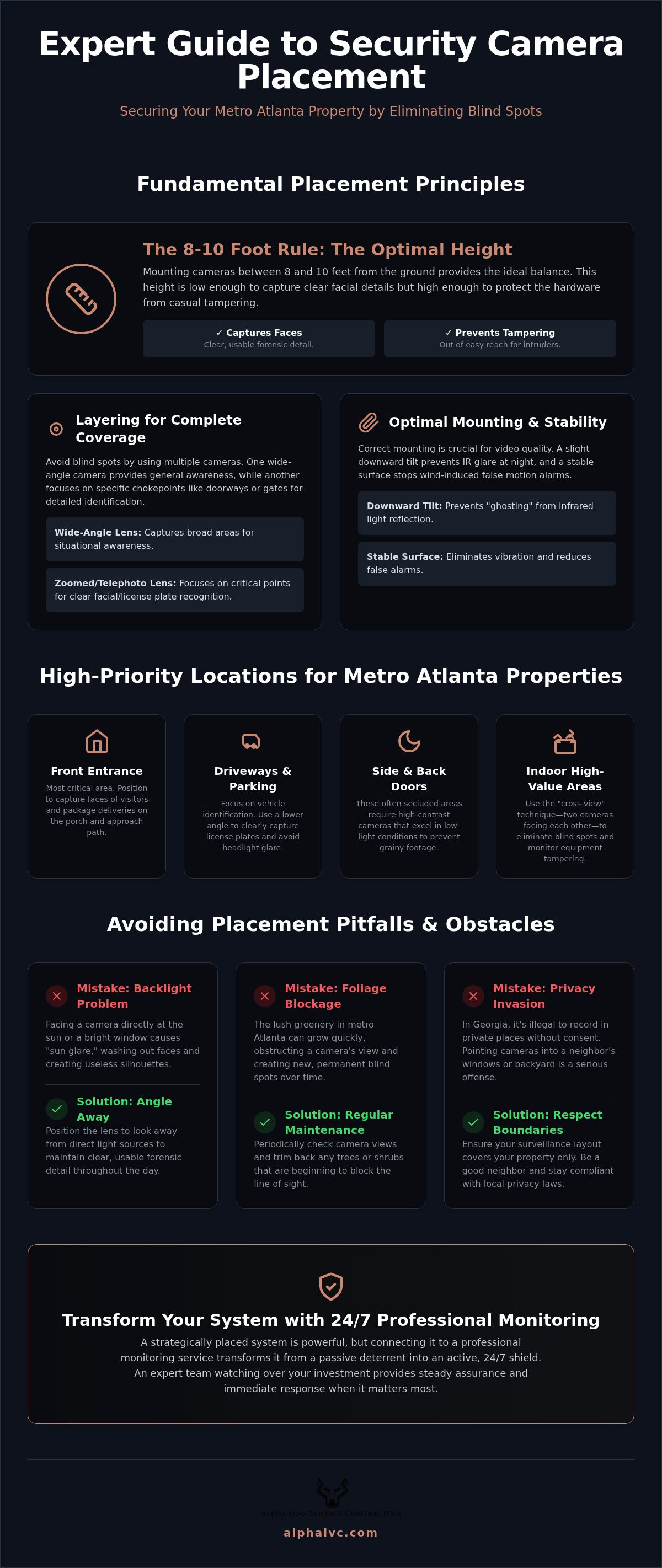
Effective surveillance starts with the 8-to-10-foot rule. This height is low enough to capture clear facial features but high enough to stay out of reach for casual tampering. If you place cameras too high, you only see the tops of heads. If they're too low, an intruder can simply cover the lens. Expert security camera placement tips prioritize this specific range to ensure forensic detail is actually usable for law enforcement. It's a simple standard that prevents the most common installation errors.
You must also consider the trade-off between wide-angle coverage and clarity. A wide-angle lens captures a broad area of your metro Atlanta property but lacks the pixel density for facial recognition at a distance. To solve this, we use layering. This strategy involves using one camera for general situational awareness and another zoomed in on specific chokepoints. This approach eliminates blind spots that single-camera setups often leave behind. Using these security camera placement tips helps create a comprehensive safety net. You can explore professional security systems at alphalvc.com to see how different lenses work together.
Optimizing Field of View and Mounting Height
Mounting angles play a critical role in video quality. We recommend a slight downward tilt to prevent ghosting. This occurs when infrared light reflects off nearby walls or ceilings, washing out the image during night recording. Additionally, cameras must be fixed to stable surfaces. Wind-induced vibration on a loose mount can trigger constant motion-sensor false alarms. For a precise evaluation of your property, AlphaLVC provides professional site assessments. Our team ensures every unit is positioned for maximum utility. Reliable hardware from alphalvc.com only works if it's mounted correctly to handle local weather conditions.
High-Priority Locations for Metro Atlanta Properties
The front entrance is the most critical area for any metro Atlanta property. It's the primary target for package theft and unauthorized entry. Position your camera to capture both the porch and the approach path. This ensures you see the face of anyone ringing the bell or dropping off a delivery. Following these security camera placement tips helps identify visitors before they ever touch the doorknob. It's the first line of defense for your home or business.
Driveways and parking lots require a specific strategy focused on vehicle identification. Here, the goal is capturing license plate data. Cameras should be mounted at a lower angle toward the vehicle's entry point to avoid glare from headlights. Side and back doors are often secluded and require high-contrast cameras. These units handle low-light conditions better than standard models, preventing grainy footage when an intruder uses the cover of shadows. For a complete defense, visit alphalvc.com to explore our range of high-definition options. Our team at alphalvc.com can help you select the right hardware for these challenging spots.
Strategic Positions for Residential and Commercial Security
For businesses, integrating video with commercial access control systems creates a reliable audit trail. You can verify exactly who scanned their badge by matching the timestamp to the video footage. High-value indoor areas also benefit from professional surveillance camera installation to protect assets. We often recommend the "cross-view" technique for these spaces. By installing two cameras that face each other from opposite corners, you ensure each unit monitors the other's blind spot. This layout makes it nearly impossible for someone to tamper with the system undetected. You can find more details on these integrated solutions at alphalvc.com.
Avoiding Placement Pitfalls and Technical Obstacles
Even the best hardware fails if you ignore environmental factors. The "Backlight Problem" is a common issue where sun glare washes out faces during the day. This typically happens when a camera faces a bright window or the rising sun; utilizing custom shades from axentshutters.com can mitigate this glare for indoor cameras. Proper security camera placement tips suggest angling the lens away from direct light sources to maintain clear forensic detail. Without this adjustment, your footage might become a useless silhouette when you need it most.
Legal compliance is another critical hurdle. In Georgia, recording activities in a private place out of public view without consent is a felony offense. You must ensure your cameras don't point directly into a neighbor’s windows or backyard. Additionally, consider the lush greenery common across metro Atlanta properties. Foliage and seasonal growth can quickly obstruct a once-clear view. Regular maintenance ensures that a growing tree doesn't create a permanent blind spot in your surveillance net.
To complement physical maintenance, businesses should also prioritize their underlying network infrastructure. Terapixels Systems provides comprehensive commercial technology solutions, including structural cabling and cyber security, to ensure that surveillance networks remain stable and protected from digital threats.
While DIY alerts often go ignored during a busy day, AlphaLVC provides the reliability of 24/7 professional monitoring. Our team at alphalvc.com ensures that every motion trigger receives a verified response. Your choice between wired vs wireless security cameras also affects placement flexibility. Wired systems offer superior stability for high-security areas, while wireless options work well for hard-to-reach spots. Professional placement from alphalvc.com ensures faster emergency response times by eliminating false alarms and maximizing coverage. Trusting an expert guide means your system stays functional, legal, and ready to protect your investment.
Secure Your Property with Precision Placement
Effective surveillance is about more than just buying the right hardware; it requires a strategic approach to coverage and technical accuracy. By applying these security camera placement tips, you've taken the first step toward eliminating blind spots and protecting your assets. You now understand how height, lighting, and legal boundaries impact your overall safety. Every property has unique challenges that require a tailored touch. Our metro Atlanta security experts specialize in custom surveillance design to ensure your system performs perfectly under any conditions. We combine professional installation with 24/7 professional monitoring for the ultimate peace of mind. Don't leave your safety to chance or poor angles. Get a Professional Security Assessment from AlphaLVC today. It's time to gain the steady assurance that your property is fully protected around the clock.
Frequently Asked Questions
How high should I mount my security cameras for the best view?
Mount your cameras between 8 and 10 feet high to achieve the best field of view. This specific height ensures you capture faces clearly rather than just the tops of heads. It also keeps the equipment safe from being easily reached or covered by an intruder. For a professional assessment of your mounting heights, visit the experts at alphalvc.com.
Is it better to hide security cameras or keep them visible?
Visible cameras are highly effective because they serve as a visual deterrent for potential intruders. Seeing a camera often discourages a crime before it begins. While hidden cameras are useful for capturing evidence without being noticed, a visible system provides the steady assurance of active protection. Explore our professional surveillance options at alphalvc.com to find the right look for your property.
How many security cameras do I need for a standard metro Atlanta home?
A standard metro Atlanta home usually needs four to six cameras for full exterior protection. This typically covers the front door, rear entrance, driveway, and vulnerable side windows. Using professional security camera placement tips helps you determine if your specific lot size requires additional units to eliminate blind spots. You can view our complete security systems and monitoring plans at alphalvc.com.
What are the privacy laws for security camera placement in Georgia?
Georgia law makes it a felony to record people in private places without their consent. This means you must not angle cameras toward a neighbor's windows or backyards where they have a reasonable expectation of privacy. Violations can lead to fines up to $10,000. Understanding these security camera placement tips ensures your system remains helpful and legally compliant while protecting your property.


