

Upgrading your electronic door lock installation in Metro Atlanta requires evaluating door compatibility, precise low-voltage cabling, and local safety codes. Commercial access control deployment demands integrated planning to connect physical lock hardware with central security management. Total investment varies based on hardware choices, system architecture, and integration requirements; contact AlphaLVC for a personalized quote.
Key Takeaways: You can install basic smart deadbolts yourself, but high-traffic commercial doors require professional low-voltage wiring and Cat6A cabling to ensure code-compliant emergency egress.
- Commercial Grade 1 hardware and hardwired controllers provide the highest reliability for high-traffic openings.
- Skip it when using battery-powered consumer locks for busy commercial perimeters as they fail.
- Choose hardwired access control for main entrances to maintain audit trails and continuous power.
- The 5-step process in this article ensures your installation meets Metro Atlanta safety codes.
Entry systems that fit your metro atlanta facility
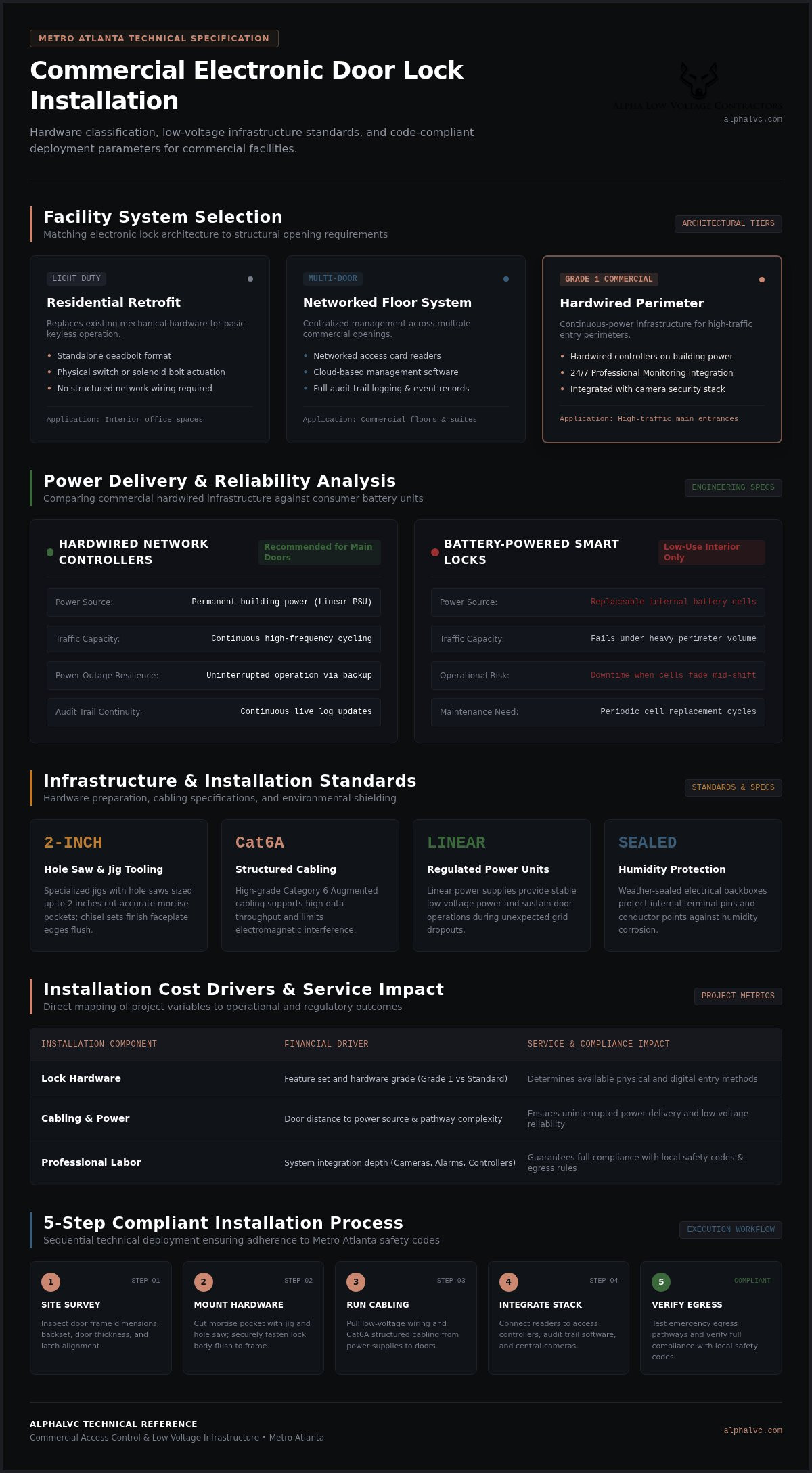
Before you order hardware, match the lock to how each door is actually used. A small office that only needs basic keyless entry can use a residential retrofit: a standalone deadbolt replaces existing mechanical hardware without network wires. A multi-door commercial floor needs networked readers tied to remote access control software so you can store lock history (audit trail) logs across the facility. A high-traffic main entrance belongs on hardwired controllers, not battery packs, so power stays continuous during peak hours.
Matching lock hardware to your facility structure prevents costly hardware failures and code violations. Standalone electronic locks actuate the bolt through physical switches or solenoids, which suits lighter-duty openings. Commercial sites that must manage several doors at once benefit from readers linked to central software, where entry events stay recorded for later review.
Integrating door controllers with a security camera system builds a coordinated security stack. Choosing hardwired connections over battery units supports high-traffic entry points: continuous power behaves like permanent utility service rather than a device you recharge between shifts, so operation stays steady when traffic spikes.
Hardwired controllers deliver strong reliability when professional low-voltage technicians align the build with local safety codes. AlphaLVC designs custom configurations that integrate hardware with 24/7 Professional Monitoring so your local site stays protected.
Tip: Perform a site survey on your door frame before ordering lock hardware to confirm backset and door thickness alignment.
Cost to install an electronic door lock
Your total spend tracks two levers you control early: which hardware grade you specify, and how complex the low-voltage path is from power source to door.
Budgeting for hardware means choosing between standalone deadbolts and commercial-grade access control devices. Higher-security commercial hardware carries a larger initial outlay than basic residential keypads, while labor fees rise with integration depth and door preparation.
| Installation Component | Financial Driver | Service Impact |
|---|---|---|
| Lock Hardware | Feature set and grade | Determines entry methods |
| Cabling & Power | Door distance to power | Ensures system reliability |
| Professional Labor | System integration level | Guarantees code compliance |
Cabling complexity pushes labor higher. Pulling low-voltage runs through solid walls takes more technical time than a standard frame install. A hardwired setup costs more at the start than battery units, yet it supplies steady power without the downtime you get when cells fade mid-shift (wireless locks depend on replaceable cells; hardwired openings draw from building power).
Project scope sets the final figure. For custom deployments, request a personalized quote from AlphaLVC for precise Metro Atlanta site estimates. Professional installation protects door infrastructure and supports full adherence to local safety codes.
Required Tools and Low-Voltage Wiring Requirements
Commercial hardware only lasts when measurements, cutting tools, and regulated low-voltage infrastructure are correct from the first cut.
You need a specialized jig and a hole saw sized up to two inches to cut accurate mortise pockets. A standard chisel set finishes faceplate edges flush. For network access controllers, hardwired power delivery outperforms temporary battery options. Running high-grade Category 6 Augmented (Cat6A) network cables supports strong data throughput and limits electromagnetic interference.
Indoor moisture is easy to underestimate: humidity corrodes internal terminal pins, degrades exposed conductor points, and triggers intermittent lock failures. Weather-sealed electrical backboxes slow that decay. Linear power supply units help the system remain operational during unexpected grid dropouts, which matters for any opening that must stay controlled during an outage.
High-voltage mishaps risk dangerous hardware failures, so keep lock power on the low-voltage side of the design. You can follow the Metro Atlanta keyless guide for a structured professional installation path; AlphaLVC technicians integrate components to local safety codes across Metro Atlanta.
Hardwired control boards suit high-traffic commercial doors; battery setups fit low-use interior offices. Correct low-voltage cabling keeps remote management and lock history logs available even when utility power blips.
Tip: Always install structured cabling using high-grade Cat6A for network access controllers to keep power and data flow stable.
5 Steps to Execute a Compliant Lock Installation
A compliant commercial install is a sequence you can verify at each stage: fit, power, control, then egress.
- Perform site survey: Technicians inspect door frame dimensions, latch alignment, and existing hardware.
- Mount hardware: Mount the electronic lock body securely to the door frame.
- Run low-voltage cabling: Run low-voltage cabling through structured cabling paths to supply steady power.
- Integrate control panel: Connect power leads and data cables to the central controller.
- Test emergency egress: Verify that free egress operates instantly during power failures to meet local safety codes.
Physical fitting tolerates almost no error: a single millimeter off can stop the bolt from throwing. Sound wiring prevents sudden power drops that interrupt daily access. You must comply with local fire regulations in Metro Atlanta so occupants can exit safely during emergencies.
Hardwired configurations fit permanent commercial facilities that need uninterrupted uptime; wireless options fit internal retrofits with lower traffic. An access control install path helps hardware join the rest of your security stack cleanly. Certified technicians complete professional installation so you retain audit trail (lock history) data under ongoing oversight.
When Smart Locks Are the Wrong Choice for Entry Points
Consumer digital door locks break down when you place them on openings they were never built to serve.
Battery-powered keypads cannot sustain heavy daily cycles at busy commercial facilities. High humidity and temperature spikes in Metro Atlanta corrode internal electronics in standard residential units. Wireless signals also face electromagnetic interference in industrial spaces, and standard deadbolts lack the mechanical endurance high-frequency entry points demand.
Heavy-duty commercial doors need hardwired access control on low-voltage cabling. Running Cat6A to powered strike plates keeps openings working when batteries would already have failed, and it yields an immutable lock history for security review. Hardwired systems join alarm panels and active 24/7 Professional Monitoring directly.
Lightweight residential hardware on commercial entry points opens security gaps. Compare consumer smart locks with heavy electromagnetic plates and the durability difference is obvious; a commercial failure at a main door leaves that perimeter exposed. Battery consumer locks still fit low-traffic interior doors, while hardwired access points belong on high-volume commercial properties. Commercial Grade 1 hardware supports compliance with local safety codes when certified technicians at AlphaLVC handle professional installation.
Map hardware to daily user counts before you buy; a site-specific quote clarifies which openings must move off battery power.
Frequently asked questions
How much does it cost to install an electronic door lock?
Overall expenses depend on hardware choices, wiring requirements, and door preparation. Standard commercial installations across Metro Atlanta vary based on whether you choose standalone battery units or integrated systems. Hardwired setups require structured cabling, which affects labor time. For exact pricing, request a personalized quote from AlphaLVC.
Is it easy to install an electronic door lock?
Setting up a basic smart deadbolt is manageable for handyman work, but proper commercial setup requires specialized low-voltage cabling skills. Precise alignment prevents lock binding and battery drain. You must also route physical wiring correctly to maintain frame integrity. Trained technicians establish correct operation from day one.
What are the disadvantages of using electronic door locks?
Battery-powered units need routine maintenance, while fully digital systems depend on continuous electrical power. Networked devices without remote management can lose off-site accessibility during network outages. Physical keypads may show wear over time. Integrating battery backups keeps entry points usable during utility failures.
Can I install a digital lock in an existing door?
Most standard exterior doors accept modern electronic hardware after minor modifications. Technicians must assess door thickness, frame alignment, and mortise pockets before mounting equipment. Existing wooden or aluminum frames often need precise drilling for strike plates. Proper site surveys prevent structural damage to your current entryways.
How do I install an electronic door lock?
Professional installation starts with removing existing mechanical hardware and inspecting door alignment. Technicians then mount the lock assembly, run low-voltage wiring if needed, and configure access credentials. You must test emergency mechanical overrides before finalizing the process. Guidance from AlphaLVC helps you secure the facility in line with local practice.
Plan Your Electronic Door Lock Installation in 2026
The same decisions you face at the start (door compatibility, low-voltage path, hardware grade, and code-compliant egress) determine whether the finished system holds up in daily Metro Atlanta use. Low-voltage security engineers at AlphaLVC evaluate your entry points and select hardware that fits each opening’s traffic and frame.
Wireless setups fall short of the reliability hardwired access points provide on busy perimeter doors. Commercial hardware joined to your network gives you direct control, meets local safety codes across Metro Atlanta, and lets you review lock history from your management software.
To verify facility readiness, visit AlphaLVC.com. To schedule a site survey or discuss professional hardware mounting, explore our professional security system installation service.


