

Network cabling installation sets the bandwidth ceiling for every workstation, camera, and door controller on your commercial floor. When you plan internet wiring installation (structured cabling installation) around network cable (Cat6A) and correctly placed drops, you support your full security system setup (security stack) and stay aligned with local safety codes in Metro Atlanta. You can request a personalized quote from AlphaLVC to determine accurate deployment costs for your facility.
Key Takeaways: Professional network cabling installation requires Cat6A copper for 10 Gbps speeds and PoE, or fiber optics for high-capacity spans exceeding 100 meters.
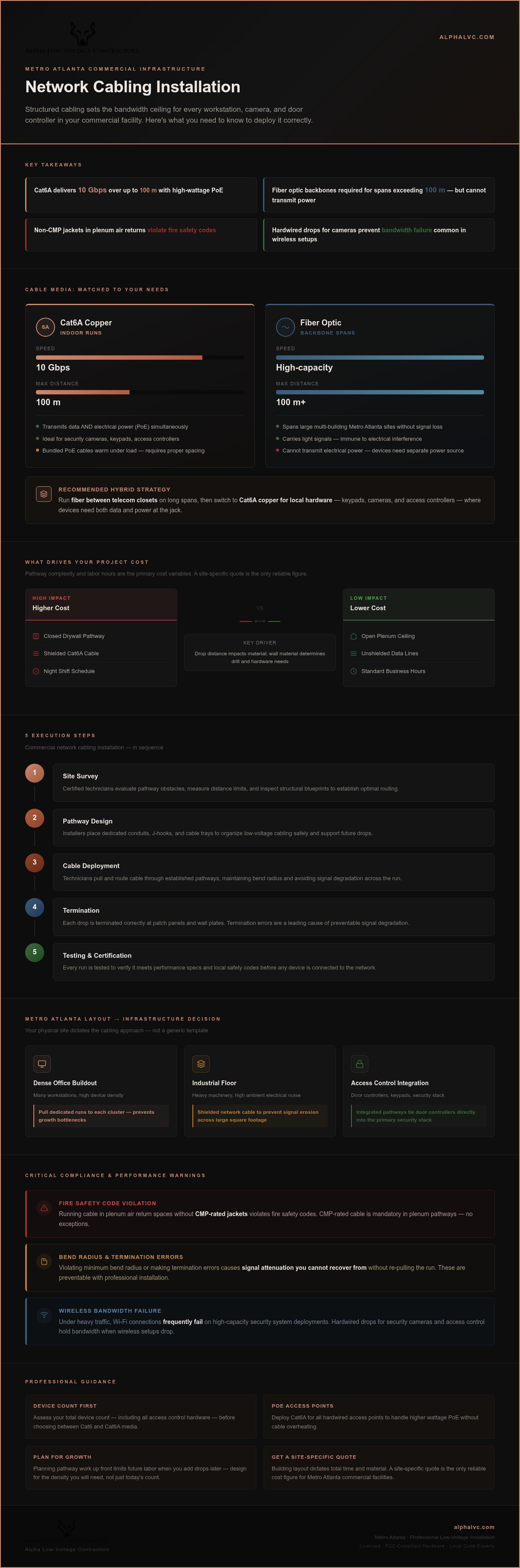
- Cat6A supports 10 Gbps speeds and high-wattage PoE over distances up to 100 meters.
- Fiber optic backbones are necessary for multi-building sites but cannot transmit electrical power.
- Unless you use CMP-rated jackets in plenum air returns, you violate fire safety codes.
- Deploy hardwired drops for security cameras to prevent bandwidth failure common in wireless setups.
Your Metro Atlanta layout decides the network infrastructure you need
Your physical site layout determines whether internet wiring installation needs standard copper runs or longer high-capacity spans. Match the media and drop plan to how you actually use the floor, not to a generic template.
Three situations come up often on commercial work:
- Dense office buildouts with many workstations: pull dedicated runs to each cluster so growth does not create bottlenecks.
- Industrial floors near heavy machinery: choose shielded network cable so ambient noise does not erode signal quality across large square footage.
- Commercial access control installation: design integrated pathways that tie door controllers straight into your primary security stack.
Selecting the correct low-voltage cabling pathway keeps operations reliable as the local business expands. Upgrading building infrastructure still requires a full review of hardware endpoints. You can align layout choices with long-term digital demand in this hardwired network guide. Wired drops, rather than wireless-only alternatives, lock in maximum bandwidth for each connected device.
Tip: Assess your total device count including access control hardware before selecting between Cat6 and Cat6A media.
Pathway complexity and labor hours drive network cabling costs
Your total project expense depends on pathway complexity, drop counts, and overall labor hours. Commercial spaces in Metro Atlanta often present specific physical installation challenges that show up line by line on the estimate.
Drop distance directly impacts material demands. Wall materials determine the necessary drill bits and mounting hardware. Running network cable through open ceilings requires less effort than pulling lines through dense drywall. Labor costs fluctuate based on whether technicians work inside standard operating hours or during night shifts. For fully integrated infrastructure, Metro Atlanta low-voltage setups cover complete cabling scopes. Building layout dictates total time, so a site-specific quote is the only reliable figure.
| Cost Factor | High Impact | Low Impact |
|---|---|---|
| Pathway Type | Closed Drywall | Open Plenum Ceiling |
| Cable Type | Shielded Cat6A | Unshielded Data Lines |
| Schedule | Night Shift | Standard Business Hours |
Internet wiring installation requires careful routing to maintain signal integrity. Opting for cabled connections rather than purely wireless setups supports operational stability under load. High-capacity security system setup deployment demands proper backbone capacity; under heavy traffic, Wi-Fi connections frequently fail. Ask the team for a precise cost estimate tied to your commercial facility.
Cat6A copper and fiber media matched to distance and power needs
Cat6A supports 10 Gbps speeds over 100 meters while powering your network devices efficiently. Choosing between copper and fiber depends on distance, power needs, and bandwidth.
A network cable uses twisted copper pairs to run high-speed data and Power over Ethernet (PoE) simultaneously. That dual capability makes copper a strong fit for security hardware within standard distances. Fiber optic cables carry light signals across large facilities without the same distance loss, yet they cannot transmit electricity. Copper remains the practical choice when a device needs both data and power at the jack.
Intensive PoE usage across extended distances warms bundled cables. Heat increases resistance, which slows overall transmission. Professional low-voltage cabling mitigates this risk through proper spacing and insulation standards.
On Metro Atlanta commercial properties, combining media types builds an efficient structured cabling backbone: longer spans between telecom closets on fiber where the design calls for it, copper feeding local hardware such as keypads. Use the keyless entry planning guide when you map the security system setup. Fiber suits large multi-building sites; copper suits shorter interior runs.
Tip: Deploy Cat6A for all hardwired access points to handle higher wattage PoE without cable overheating.
5 Execution steps for commercial network cabling installation
A systematic deployment strategy prevents costly signal attenuation and keeps peak bandwidth available across your physical infrastructure. Planning pathway work up front also limits future labor when you add drops later.
- Site survey: Certified technicians evaluate pathway obstacles, measure distance limits, and inspect structural blueprints to establish optimal routing.
- Pathway design: Installers place dedicated conduits, J-hooks, and cable trays to organize low-voltage cabling safely.
- Cable deployment: Technicians pull fire-rated network cable through prepared pathways without exceeding tension limits.
- Termination: Engineers punch down connections onto patch panels and jacks using standardized T568B pinouts.
- Testing and certification: Testing tools verify wiremap standards, measure signal loss, and output compliance reports.
The same sequence applies when camera pathways are part of the job; the camera cabling guide walks through those commercial details. AlphaLVC delivers execution aligned with local safety codes so Metro Atlanta facilities get hardwired precision where uptime matters. Schedule professional setup when you need certified data stability on day one.
Plenum pathways require local code permits before you pull cable
Metro Atlanta municipalities require specific building permits for low-voltage cabling runs through air-handling spaces. Filing early prevents job delays and forced teardowns during municipal inspections.
Failing to use CMP-rated jackets in drop-ceiling air returns violates fire safety rules and can release hazardous fumes during a fire. Running standard non-plenum wire in air spaces is a common fail point: code enforcement officers will reject the inspection. Building safety requires certified low-voltage contractor installation to satisfy local safety codes.
AlphaLVC handles jurisdiction permitting so compliance holds across Metro Atlanta. You avoid severe legal liabilities when licensed technicians perform the internet wiring installation. Network cable pulled through plenum pathways must meet strict flame-spread resistance requirements, and proper permit filings keep your commercial security system setup inside local code rules. Work with AlphaLVC when you need compliant, professional results for the facility.
Bend radius and termination errors cause signal degradation you can prevent
Improper internet wiring installation causes severe network cable degradation that destabilizes an enterprise network. The failures usually start as small physical mistakes, not as software issues.
Exceeding bend radiuses creates microscopic copper kinks, which cause signal attenuation (loss of signal strength) that drops camera feeds. Termination errors at the patch panel disrupt power delivery to security equipment. Electromagnetic interference from high-voltage conduit degrades the wireless backbone you may still rely on for overflow traffic.
These physical layers directly support your security system setup. Poor connections generate dropped packets, breaking live video streams and delaying door-opening commands. Hardwired links therefore need precision testing and certification against local safety codes throughout Metro Atlanta. Review detailed technical requirements at AlphaLVC.com, then book a full site survey before you deploy essential hardware.
Hardwired cabling holds bandwidth when wireless setups drop
Hardwired access points outperform mesh-only wireless office setups for commercial security loads. High-definition video surveillance and access control demand uninterrupted bandwidth that wireless signals cannot guarantee when radio frequency interference is present.
Wireless networks fail under heavy traffic. Physical network cable delivers stable Power over Ethernet to each security camera without the dropouts that mesh hops introduce. For a Metro Atlanta facility, an integrated security system setup needs constant uptime, which is why AlphaLVC focuses on dedicated internet wiring installation for local properties. Leaving mission-critical coverage on wireless alone leaves coverage gaps you cannot afford during an incident.
Access control and video rely on a stable cabling backbone
Your internet wiring installation is the backbone for physical security and cloud-based management. Without solid drops, cameras and controllers inherit every fault in the path.
Low-voltage contractors build this network cable infrastructure to link IP cameras and door controllers directly. Integrating hardware with 24/7 Professional Monitoring supports rapid emergency response across Metro Atlanta. Wireless setups often fail during signal drops; hardwired runs provide steady power delivery and remove unexpected coverage loss.
Field pattern (situation → action → result): On projects reviewed through AlphaLVC.com, poor cabling first showed up as subtle video lag at primary entry points. Crews replaced the weak runs with proper low-voltage cabling and certified terminations. Lag cleared and the hardware no longer progressed toward total failure, while the security system setup stayed FCC-compliant.
Early drywall coordination keeps Metro Atlanta buildout timelines intact
Coordinate internet wiring installation early during drywalling phases if you want to avoid construction delays. Once walls close, every missed drop turns into a tear-out.
From client work, early collaboration between technicians and general contractors prevents costly wall openings later. That alignment keeps the commercial project on schedule and compliant with local safety codes. You must lock low-voltage cabling drop locations before main walls close; missing the window disrupts hardware placement for network cable and security endpoints alike.
Choose professional installation through AlphaLVC when you need schedules synchronized across Metro Atlanta buildouts and full coverage on opening day.
Frequently asked questions
What is a typical cost of network cable installation?
The total investment depends on cable types, total drop counts, and building architecture. Physical layout, wall materials, and ceiling height drive your final quote higher or lower. Contact AlphaLVC.com to schedule a site survey for an exact estimate.
How much does network cabling cost?
Project expenses vary based on spatial layout, run lengths, and hardware requirements. Facilities with high ceilings or complex fire ratings require additional labor. A customized quote from AlphaLVC.com evaluates those factors on your commercial property.
What network cabling services are offered?
Services include planning, pathway creation, and internet wiring installation. Technicians deploy high-performance network cable to connect equipment safely. Systems undergo testing to ensure compliance with local safety codes.
Do you provide fiber optic installation?
Enterprise environments in Metro Atlanta often use high-speed fiber backbones to link equipment rooms and carry heavy data traffic between closets. When a design calls for that media, certified installers complete proper testing so the finished backbone meets reliability targets.
Can you install access control and video surveillance?
Integrated security system setup deployments cover electronic locks, cameras, and network backbones. Systems combine hardwired connections with 24/7 Professional Monitoring for continuous protection. Licensed technicians handle field hardware so facility coverage stays consistent.
Complete Your Internet Wiring Installation in Metro Atlanta
A professional internet wiring installation ensures your network infrastructure supports critical commercial applications in 2026. The same decision thread that opened this guide still applies: choose media and pathways that match device density, power needs, and code rules, then certify the plant before you depend on it.
Proper physical infrastructure remains vital for reliable data delivery. Standard network cable delivers sustained 10 Gbps speeds and high power transmission for hardware integrations. Low-voltage requirements demand systematic cable routing that satisfies local safety codes across the facility.
The technical team at AlphaLVC brings licensed low-voltage contractor expertise to each project and builds integrated systems aimed at uptime. You can review security installation options when you expand the security stack (security system setup). Contact the specialists to schedule an on-site evaluation for your project.


