

A duplicated badge may open a door, but that doesn’t mean it meets your business’s security and recordkeeping needs. When assessing commercial keyless entry systems Atlanta businesses use, the question isn’t only whether a card can be copied. It’s whether the credential works with your readers and software, and whether you can manage access clearly.
You may need to issue replacements without encouraging badge sharing or creating gaps in access records. This guide explains how duplication differs from system-managed enrollment, how physical cards compare with mobile credentials, and what to check before changing your setup. To prepare for an assessment, gather details about your access control system, readers, credential process, and oversight needs. An access control professional can help determine which options suit your installed equipment and what audit trail features it supports.
Key Takeaways
- Card duplication copies an existing credential. It is different from assigning access through system software.
- Before choosing a credential option for commercial keyless entry systems Atlanta businesses use, confirm compatibility with your readers and access control system.
- Compare duplication, managed card enrollment, and mobile credentials by how permissions can be changed and lost credentials handled.
- For an installer assessment, list the doors, readers, credential types, and access groups. Ask about compatibility and audit trail features.
How card duplication fits into commercial keyless entry systems in Metro Atlanta
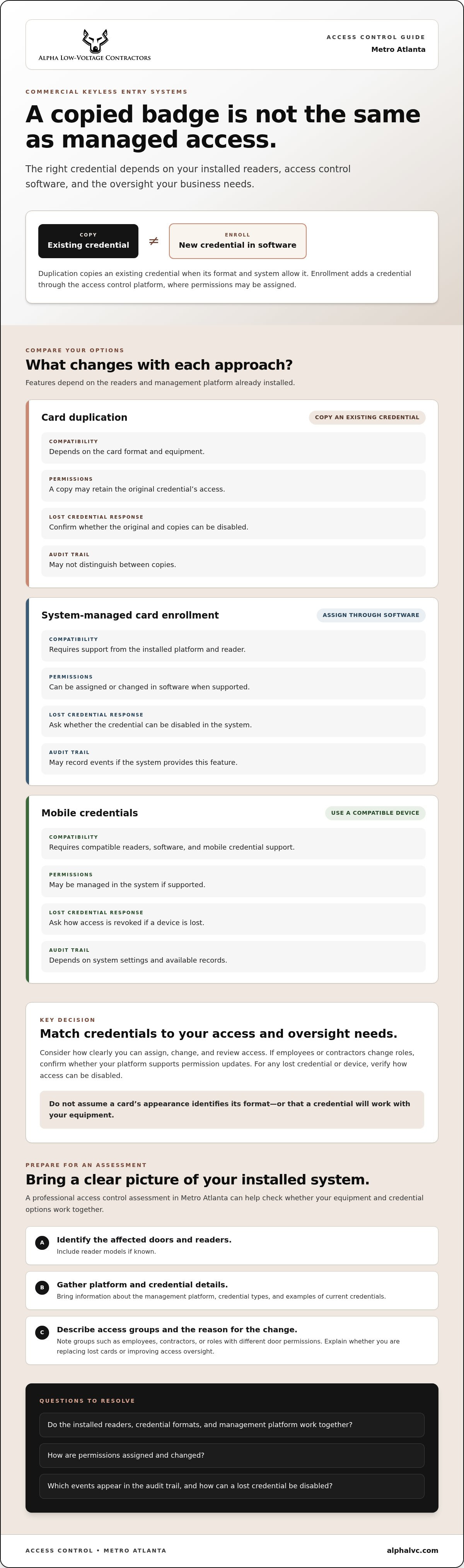
For businesses comparing commercial keyless entry systems Atlanta options, card duplication can seem like a quick way to give another employee access. But copying a credential is not the same as issuing one through the access control system. Compatibility depends on the credential format, reader, and management platform already installed. Check those details before ordering or copying cards.
Credential duplication means copying an existing access credential, when its format and system allow it. A newly enrolled card is different: an administrator adds it to the software and assigns permissions, such as which doors it can open. An overview of keycard lock technology describes credential types including magnetic stripe, RFID, and NFC. Their use in keycard systems generally does not mean a particular card can be copied or will work with your equipment.
What determines whether a commercial access card can be duplicated?
Start by identifying the reader model, credential type, and management platform. A card’s appearance may not tell you which format it uses. Ask an access control professional to check the equipment and confirm compatibility before making changes. A replacement card enrolled in the system can have its own permissions. A copied credential may be treated as the same credential, depending on how the system reads and records it.
That distinction matters when you need to know who accessed a door. If employees, contractors, or staff in changing roles share copies, it may be harder to link access to a specific person. When copies are read as the same credential, the audit trail may not distinguish between them. Review how access is assigned, changed, and removed, then decide whether duplication gives you enough oversight. A professional assessment in Metro Atlanta can help you evaluate your existing setup without assuming that duplication is supported.
Compare card duplication with managed cards and mobile credentials
Each option handles access and oversight differently. Use the comparison below as a starting point, not a compatibility guarantee. Available features depend on your installed readers and management platform.
| Option | Compatibility | Permission changes | Lost credential response | Audit trail |
|---|---|---|---|---|
| Card duplication | Depends on the card format and equipment | A copy may retain the original credential’s access | Ask whether the original and copies can be disabled | May not distinguish between copies |
| System-managed card enrollment | Requires support from the installed platform and reader | Can be assigned or changed in software when supported | Ask whether the credential can be disabled in the system | May record events if the system provides this feature |
| Mobile credentials | Requires compatible readers, software, and mobile credential support | May be managed in the system if supported | Ask how access is revoked if a device is lost | Depends on system settings and available records |
Which credential approach fits your access and oversight needs?
If your current process meets your needs and the equipment is supported, keeping it may be simpler than changing systems. System-managed enrollment can make it easier to adjust permissions when employees or contractors change roles, if your platform supports those controls. Mobile credentials may offer another option, but check reader compatibility and how your organization would handle a lost device.
For commercial keyless entry systems Atlanta businesses rely on, weigh convenience against how clearly you can assign, change, and review access. Ask what events the system records, who can manage permissions, and how a lost credential can be disabled. To discuss your installed access control, contact AlphaLVC about Metro Atlanta access control.
Plan a commercial keyless entry assessment with a Metro Atlanta installer
A useful assessment starts with clear information about your existing system and the change you need. Before speaking with an installer, make a short inventory:
- List each affected door and identify its reader, if known.
- Gather details about the management platform and examples of current credentials.
- Note credential types and access groups, such as employees, contractors, or roles with different door permissions.
- Describe the reason for the change, such as replacing lost cards or improving access oversight.
What should you prepare before requesting an access control consultation?
Bring your inventory and ask the installer to check whether the readers, credential formats, and management platform work together. Confirm how permissions are assigned and changed, which events appear in the audit trail, and how lost credentials can be addressed. Ask what maintenance the system may need and which parts of the existing setup can remain.
Clarify the project scope, too: which doors and devices are included, what work is proposed, and how the installation will connect with your current access control and broader security system. For a Metro Atlanta site, ask which local safety codes apply to the specific location and planned work, and how those requirements will be verified.
These details help you compare commercial keyless entry systems Atlanta businesses may consider without assuming every credential or feature will work with your equipment. If you’re preparing to change commercial access control in Metro Atlanta, contact AlphaLVC about commercial access control to discuss an assessment of your existing setup.
Choose a credential process you can manage with confidence
Card duplication isn’t a universal shortcut. Whether it works depends on your credential format and access control equipment. Compare it with system-managed cards and mobile credentials by checking compatibility, permission changes, lost-credential response, and the audit trail your system supports.
Before changing commercial keyless entry systems Atlanta businesses depend on, gather details about the affected doors, readers, credentials, and access groups. A professional assessment can clarify what fits your current setup and how access control connects with your broader security system.
AlphaLVC installs and maintains access control and security systems for businesses in Metro Atlanta. The company also provides surveillance cameras and 24/7 professional monitoring. Contact AlphaLVC to request a commercial access control consultation and discuss your system and next steps. A compatibility review can help you choose a credential process that supports the level of access oversight your business needs.
Frequently Asked Questions
Can a business duplicate an access card?
A business may be able to duplicate an access card, but feasibility depends on the credential format and installed access control system. A familiar-looking card may use a format the existing reader cannot accept. Before ordering copies, identify the reader and credential type, then ask an access control professional to verify compatibility and whether duplication fits your oversight needs.
Is duplicating an access card the same as adding a new credential?
No. Duplication copies an existing credential; it doesn’t necessarily create a separate record or permission set. Adding a credential means enrolling it through compatible access control software and assigning access, such as approved doors or groups, if the platform supports those controls. Ask your system provider how each method affects credential identity, permissions, and event records before choosing a process.
What should you do if an employee loses a commercial access card?
Follow your organization’s lost-card procedure and promptly notify the person responsible for access control. Ask the system provider whether the credential can be disabled and replaced in the installed platform. If the system records credential events, check its audit trail according to your procedures. Don’t assume a replacement card automatically cancels the lost one. Confirm the steps for your equipment and document the response.
Can a commercial keyless entry system use mobile credentials?
Yes, a commercial keyless entry system may support mobile credentials, but availability depends on the installed management platform, readers, and supported credential options. For commercial keyless entry systems Atlanta businesses are assessing, ask an access control professional to verify whether the existing equipment can accept mobile credentials. Confirm how enrollment, permission changes, lost-device response, and event records would work before planning a system change.


