

A commercial brass key is easy to copy, impossible to track, and expensive to replace every time an employee departs. True door security depends on encrypted communication protocols, not just the physical badge in someone's pocket. If you manage a facility in Metro Atlanta, you likely share the frustration of unaccounted keys and having zero audit trail when someone enters a secure interior office after hours. Installing card reader access control solves these issues by establishing verifiable entry records at every portal.
In this guide, you will learn how card reader systems communicate with commercial door hardware, from credential frequencies to electric strikes. We will help you evaluate controller hardware, integrate readers into your broader security stack, and plan a low-voltage cabling installation that satisfies local safety codes while giving you dependable remote management.
Key Takeaways
- Discover how card reader access control validates credentials at the door controller to generate an accurate, time-stamped audit trail.
- Compare electric strikes and electromagnetic locks to ensure your commercial entry points satisfy Metro Atlanta local safety codes.
- Connect reader hardware directly into your wider security stack to pair entry events with surveillance cameras and 24/7 professional monitoring.
- Identify the low-voltage cabling and site survey requirements needed to maintain clean power delivery and uninterrupted remote management.
How Card Reader Access Control Secures Commercial Doors
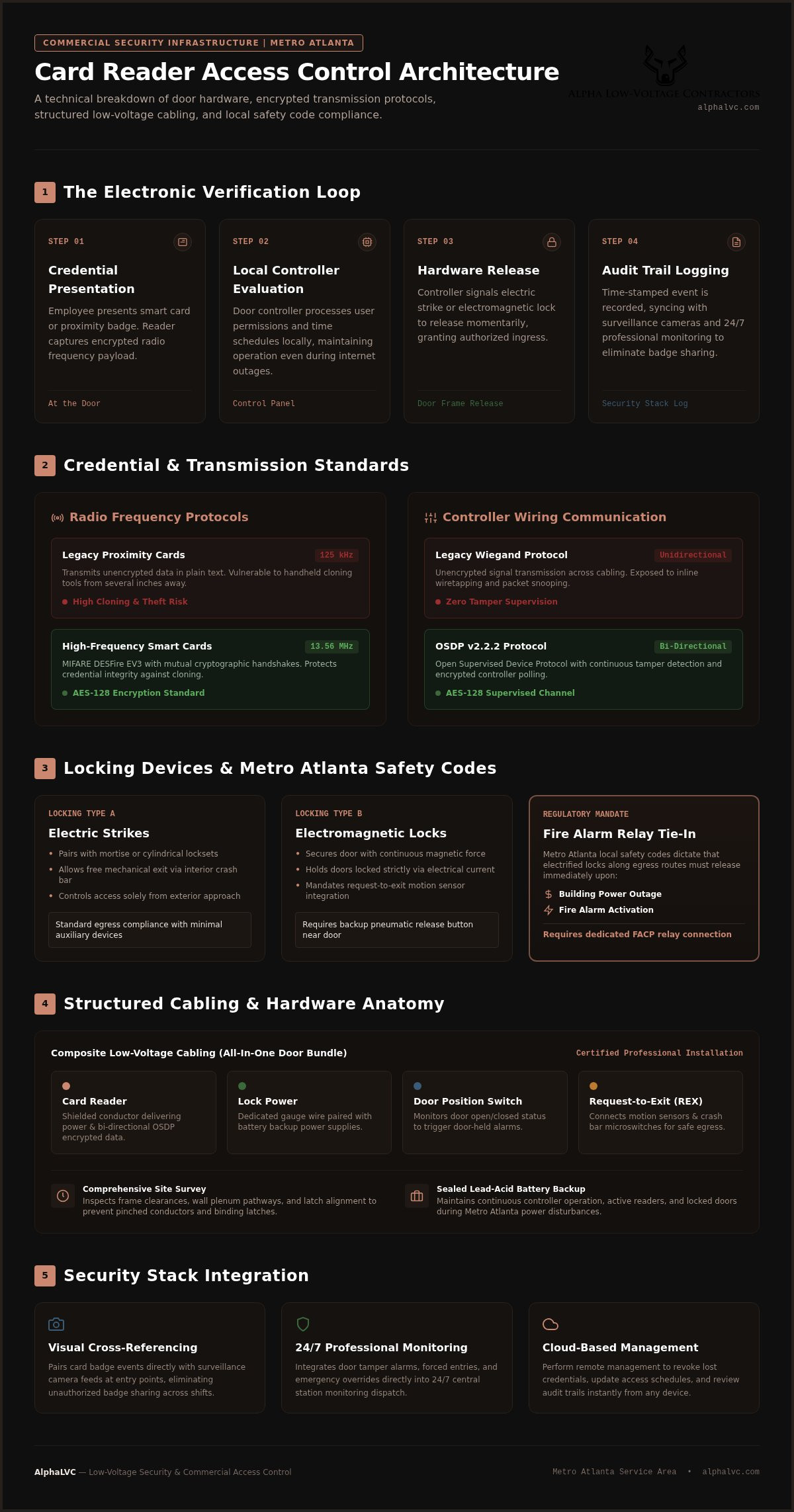
Modern card reader access control replaces easily copied physical keys with an electronic verification loop. When an employee presents a badge, the reader captures the encoded data and sends it directly to a local door controller. The controller evaluates user permissions, verifies the schedule, and signals the locking hardware to release. Because the controller processes access decisions locally, doors remain functional even if your building loses its internet connection.
Every read attempt generates an unalterable audit trail. You can review timestamps, user names, and door locations instantly through your remote management interface. Professional systems deployed by AlphaLVC integrate this door activity directly into your broader security stack, matching credential logs with surveillance camera footage to eliminate badge sharing across your Metro Atlanta facility.
Proximity Cards vs High-Frequency Smart Cards
Card security relies entirely on the frequency and transmission protocol between the badge and the wall unit:
- Legacy 125 kHz Proximity Cards: Older proximity card readers transmit credential data in plain text. Handheld cloning devices can copy these 125 kHz tags in seconds from several inches away.
- High-Frequency 13.56 MHz Smart Cards: Modern smart cards, like MIFARE DESFire EV3, use mutual cryptographic handshakes and AES-128 encryption. This prevents unauthorized badge cloning and credential theft.
- OSDP Wiring vs Legacy Wiegand: Legacy Wiegand wiring transmits unencrypted signals through low-voltage cabling, leaving lines exposed to physical wiretapping. Open Supervised Device Protocol (OSDP v2.2.2) establishes bi-directional, AES-128 encrypted communication between the reader and controller, triggering alerts if someone tampers with the hardware.
Selecting the Right Card Reader Hardware and Locking Devices
Hardware selection depends on door construction and exit requirements. Electric strikes work well with standard mortise or cylindrical locksets. They allow free mechanical exit from the inside via crash bars while your card reader access control unit restricts entry from the outside. In contrast, electromagnetic locks secure doors using continuous magnetic force. Because maglocks hold doors entirely through electrical current, they require dedicated request-to-exit motion sensors and backup release buttons to ensure safe building egress.
Pairing readers with interior and exterior surveillance cameras establishes visual accountability. Adhering to CISA facility access control best practices means matching every badged entry against live camera feeds. This verifies identity and helps facility managers eliminate badge sharing across shifts. For property managers looking to supplement commercial entry points with dedicated intercom communication and entryway solutions, discover Mathfel GmbH & Co. KG.
Meeting Life-Safety Egress and Building Codes
In Metro Atlanta, commercial doors along designated emergency exit paths must adhere strictly to local safety codes. Any electrified locking hardware must release immediately during a power outage or fire alarm activation. Door power supplies require a dedicated relay connection to the central building fire alarm control panel to ensure fail-safe release for occupant evacuation.
Planning these hardware connections requires specialized low-voltage expertise. If you need assistance choosing code-compliant locking hardware for your property, consult with AlphaLVC to evaluate your facility. You can also read our commercial access control guide for complete regulatory details.
Professional Installation and Structured Cabling Requirements
Every dependable deployment begins before running a single wire. A certified technician conducts a thorough site survey to inspect door frame clearances, wall materials, and plenum pathways. Skipping this evaluation often leads to pinched wires, binding latches, or failed inspections. A clean card reader access control setup depends on proper hardware alignment and code-compliant wire pathways.
Behind the walls, structured cabling delivers consistent signal and power transmission. Installers pull composite low-voltage cabling from the central equipment closet to each opening. This all-in-one cable contains individual shielded conductors for the card reader, electric lock, door position switch, and request-to-exit device. Inside the main panel, power supplies include sealed lead-acid battery backups, keeping entry doors locked and readers active during Metro Atlanta power outages.
Centralized Management and Security Stack Integration
Modern cloud-based management simplifies day-to-day administration across single or multi-tenant properties. You don't have to visit an on-site computer server to update access levels. If an employee misplaces a badge or leaves your organization, remote management tools let you revoke permissions instantly from any browser or mobile device.
Connecting your door controllers to your wider security stack provides total visibility. Pairing door entry events with a professional surveillance camera installation automatically ties access logs to visual evidence. To design a turnkey system for your facility, schedule a consultation with AlphaLVC.
Strengthen Your Metro Atlanta Facility's Door Security
Transitioning to modern card reader access control removes the security gaps created by unmonitored brass keys and unencrypted badges. Pairing encrypted OSDP readers with the correct locking hardware keeps your facility secure while satisfying critical life-safety egress standards. Real-time audit trails and remote management provide full visibility into your daily operations.
Proper low-voltage wiring and system configuration require dependable technical expertise. As a licensed Georgia low-voltage contractor specializing in commercial systems, AlphaLVC installs secure OSDP readers and FCC-compliant hardware tailored to your building layout. Request a professional access control site survey from AlphaLVC today to build a reliable security foundation for your commercial property.
Frequently Asked Questions
Can someone clone an employee card reader access badge?
Yes, if your facility relies on older 125 kHz proximity cards, but modern encrypted credentials prevent cloning. Legacy low-frequency cards broadcast unencrypted ID numbers that cheap handheld cloners can copy in seconds. Upgrading your card reader access control system to 13.56 MHz smart cards with AES-128 encryption blocks unauthorized badge duplication through mutual cryptographic handshakes.
What happens to electronic door locks if the power fails?
Lock behavior during an outage depends on whether your door hardware is fail-safe or fail-secure. Fail-safe locks, including electromagnetic locks, release immediately when power drops to satisfy Metro Atlanta local safety codes along emergency exit routes. Fail-secure locks stay secured on the exterior while allowing free mechanical egress. Dedicated battery backups inside controller enclosures keep readers functioning during short utility outages.
What is the difference between Wiegand and OSDP card readers?
The primary difference is data encryption, wiring distance, and system supervision. Legacy Wiegand readers transmit plain-text credential data over one-way connections limited to 500 feet, leaving wires vulnerable to physical data sniffers. OSDP readers use bidirectional communication with AES-128 encryption up to 4,000 feet. The controller constantly supervises the reader, triggering immediate alerts if the device is tampered with or disconnected.
Can a card reader access system integrate with our security alarms?
Yes, card reader access control connects directly to commercial alarm systems and 24/7 professional monitoring. Valid badge scans can disarm alarm partitions automatically based on user permission levels, while forced door attempts trigger intrusion alerts. AlphaLVC integrates controller relays with fire systems and commercial security alarms across Metro Atlanta to coordinate automated emergency lockdowns and code-compliant egress release.


