

Adding cameras may not address employee safety if access control and monitoring operate separately. Choosing employee safety security systems Atlanta businesses can rely on starts with planning these layers together, based on how people enter, move through, and work in your facility.
You need security that supports employee safety without creating unnecessary friction or overlooking privacy. This guide explains how to assess cameras, access control, and 24/7 professional monitoring as parts of one security stack. You’ll learn how a site survey can match equipment to workplace routines, what to consider when connecting system components, and how professional installation supports reliable operation. For Metro Atlanta workplaces, a clear plan helps you compare options against your site’s needs and daily operations.
Key Takeaways
- Plan employee safety security systems Atlanta workplaces around three goals: managing entry, viewing relevant areas, and responding to monitored events.
- Map your site, define who needs access, identify camera coverage needs, and assess how monitoring fits your operations.
- Match remote management and event records to staff roles while accounting for workplace routines and privacy.
- A site survey can guide professional installation and coordinate cameras, access control, and monitoring as one security plan.
How Employee Safety Security Systems Address Workplace Needs in Metro Atlanta
Employee safety security systems coordinate tools for managing who enters a workplace, viewing relevant areas, and monitoring security events. Cameras, access control, and professional monitoring serve different purposes. Planned together, they form a security stack shaped around your site, staff routines, and operating hours. For Metro Atlanta businesses, the goal is to address specific workplace needs without adding avoidable friction to daily operations.
Security technology supports, but does not replace, workplace policies, staff training, or established response procedures. A broad overview of Occupational Safety and Health (OSH) helps distinguish the wider field of employee health and safety from the specific role security equipment can play. Monitoring can provide oversight of security events, but it should not be treated as a substitute for your organization’s procedures or as a guarantee of an emergency outcome.
Which workplace safety needs should the system address?
Start by identifying where access needs to be managed, how visitors move through the site, and which work areas need visibility. Consider employee entrances, reception and waiting areas, shared corridors, and locations where staff may work outside regular business hours. For example, you may need different access rules for a reception area and a staff-only room. Then decide which areas need access control, which require camera coverage, and whether monitored security events fit your operating plan.
- Entry management: Define which staff, visitors, and service personnel need access to specific areas.
- Visitor movement: Identify where visitors should check in and which spaces should remain staff-only.
- Visibility: Focus camera planning on relevant entrances and shared areas while respecting workplace privacy.
- Monitoring: Determine which security events should be routed for professional monitoring.
The right security layers reflect how your workplace operates, not a generic camera or access-control checklist. Planning employee safety security systems Atlanta businesses can depend on means accounting for shift changes, opening and closing routines, visitor traffic, and areas that may be unoccupied at certain times.
How to Compare Employee Safety Security Systems for a Metro Atlanta Workplace
Compare systems against the way your workplace functions, not just a list of devices. For employee safety security systems Atlanta businesses are evaluating, a site survey can connect staff roles, movement, and operating hours to camera placement, access permissions, monitoring, and network planning. Guidance from the Occupational Safety and Health Administration (OSHA) addresses workplace safety broadly. Security technology should support, not replace, your organization’s safety procedures.
What should a workplace site survey establish?
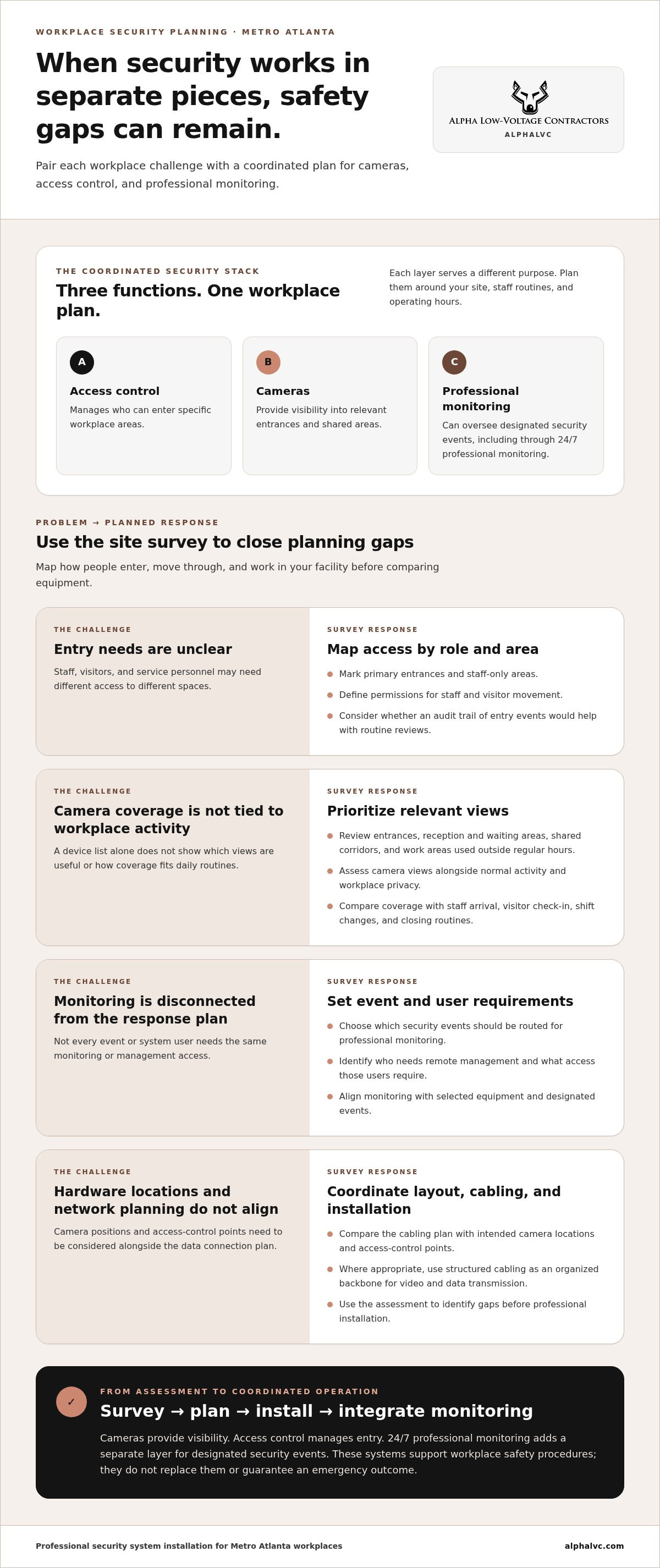
A site survey should map primary entrances, staff-only areas, visitor routes, and locations where camera coverage may be useful. It should also show how access control and cameras can fit existing routines, such as staff arrival, visitor check-in, shift changes, and closing. Use the survey to compare how each system component addresses a defined need, and to identify gaps before installation.
- Map the site: Mark entrances, interior routes, shared spaces, and areas that need controlled access or visibility.
- Define access needs: Match permissions to staff roles and identify how visitor access should work. Consider whether an audit trail of entry events would help with routine reviews.
- Plan camera coverage: Prioritize relevant entrances and shared areas. Assess camera views in the context of normal activity and workplace privacy.
- Assess monitoring and management: Decide which events should be professionally monitored, who needs remote management, and what access those users require.
Network design matters, too. Where appropriate, structured cabling provides an organized backbone for video and data transmission. Compare the cabling plan with the intended camera locations and access-control points. A coordinated assessment can inform commercial access-control planning and surveillance camera installation. AlphaLVC provides professional security system installation for Metro Atlanta workplaces.
Plan Professional Installation and Monitoring with AlphaLVC in Metro Atlanta
A workplace security plan should move from assessment to coordinated operation. AlphaLVC conducts a site survey to understand your entrances, staff routines, visitor flow, and areas where cameras or access control may be needed. That assessment informs system planning, professional installation, and how 24/7 professional monitoring fits into the security stack. This gives Metro Atlanta businesses a plan based on their actual site rather than equipment selected in isolation.
- Survey: Review the workplace layout, access points, and daily activity.
- Plan: Set camera locations and access permissions around staff roles and work routines.
- Install: Coordinate cameras and access control as connected parts of the system.
- Integrate monitoring: Align professional monitoring with the selected security equipment and the events designated for monitoring.
What to expect from an integrated security plan
Cameras provide visibility, while access control manages entry. 24/7 professional monitoring adds a separate layer for designated security events. These functions complement one another, but they do not replace workplace procedures or guarantee a particular emergency outcome. The National Institute for Occupational Safety and Health (NIOSH) offers broader resources on preventing work-related injuries and illnesses. These resources can help frame security technology as one part of a wider workplace safety approach.
AlphaLVC brings Metro Atlanta expertise to installation planning, with FCC-compliant hardware and attention to applicable local safety codes. Planning accounts for the workplace and relevant site requirements. AlphaLVC also provides security system maintenance to help keep installed equipment aligned with your needs.
If you’re evaluating employee safety security systems Atlanta businesses can tailor to their workplace, discuss your workplace security needs with AlphaLVC.
Make Your Workplace Security Plan the Next Step
Use your assessment as a working plan, not a one-time checklist. As staffing, visitor patterns, and work areas change, review whether security settings and equipment still fit how your team operates. A clear plan for employee safety security systems Atlanta workplaces can build on keeps security decisions connected to everyday needs.
AlphaLVC brings Metro Atlanta expertise, a low-voltage contractor license, professional installation and maintenance, and 24/7 professional monitoring to workplace security planning. Put those services to work in a plan shaped around your site and priorities. Discuss employee safety security systems for your Metro Atlanta workplace with AlphaLVC.
Frequently Asked Questions
Can employee safety security systems include cameras and access control?
Yes. Employee safety security systems Atlanta businesses plan can include both surveillance cameras and access control. For example, credentials can limit entry to designated staff areas, while cameras provide visual context in selected shared spaces. Define each feature’s purpose, who can view footage, and how access permissions should change when staff roles change. Include privacy in the camera placement plan.
How does 24/7 professional monitoring work with a business security system?
24/7 professional monitoring provides oversight of security events designated in the system’s configuration. The equipment detects or records an event, and monitoring handles it according to the system arrangement. Identify which events should be monitored and keep that process distinct from your workplace response procedures. Monitoring supports a security plan, but it does not guarantee a particular emergency outcome.
What should a site survey cover before installing workplace security systems?
A site survey should review the building layout and existing security equipment, along with possible camera views and access-control locations. Note obstructions that could affect visibility, privacy-sensitive spaces, and network or cabling considerations. Bring a current floor plan and describe any planned changes to workspace use. This helps shape an installation plan around actual site conditions.
Can an existing workplace security system be maintained or upgraded?
Yes. Existing workplace security systems can be maintained, and upgrades can address changing site needs. A review can document the installed equipment, identify maintenance needs, and clarify which functions you want to add or change. AlphaLVC provides security system installation and maintenance for Metro Atlanta businesses. The upgrade plan should account for the existing setup rather than assume every component can be retained.


