

TL;DR: Commercial retail store security cameras require hardwired Cat6A cabling and strategic mounting between 8 and 10 feet to ensure reliable facial identification and tamper resistance.
- Professional installations average between $255 and $1,379 per camera location across 102 market samples.
- Except when using anonymized movement mapping, advanced AI facial tracking requires explicit privacy disclosures.
- Deploy hardwired IP cameras for retail environments to avoid the signal loss common in DIY wireless systems.
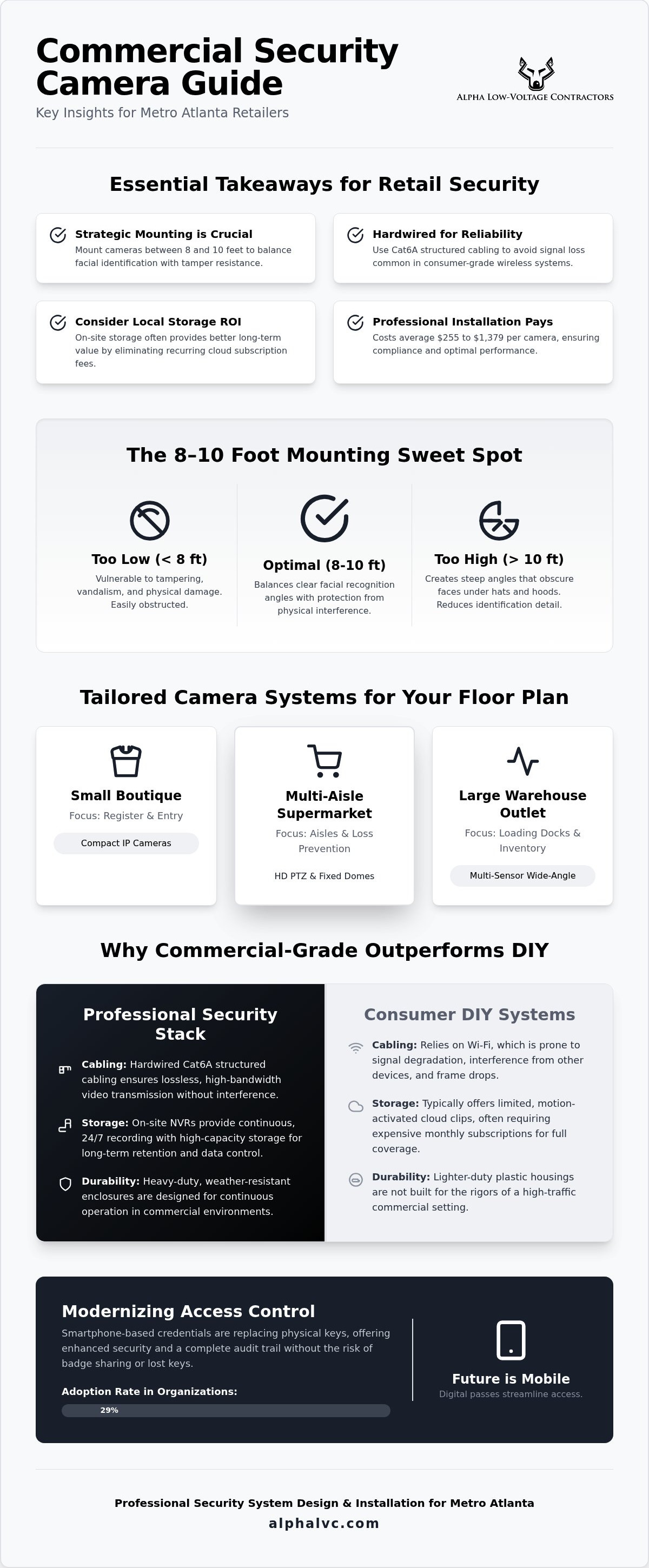
- Local storage often provides better ROI than cloud subscriptions by eliminating recurring monthly server fees. Commercial-grade retail store security cameras (surveillance cameras) require strategic placement between 8 and 10 feet high to balance clear facial identification with physical tamper resistance. Across the commercial market, complete hardware and monitoring setups require a multi-tiered investment per location. The decision path is practical: match hardware to your floor plan, use commercial cabling and storage built for continuous duty, then set mounting height and analytics so coverage holds up under real store traffic. AlphaLVC delivers hardwired security system (security stack) designs for Metro Atlanta businesses needing total perimeter coverage.
Match Camera Setups to Boutique, Supermarket, and Warehouse Floors
Choosing security cameras depends on your store floor plan and inventory layout. Three patterns show up often: a Buckhead boutique usually needs compact IP cameras aimed at the register and entry points; a multi-aisle supermarket in Decatur benefits from high-definition PTZ and fixed domes along main aisles for loss prevention; a large warehouse outlet calls for multi-sensor wide-angle units on loading docks and inventory zones. Hardware fitted to that footprint closes dead zones instead of leaving gaps between aisles and doors.
For comprehensive coverage, Metro Atlanta Alarms, Security Cameras & Access Control integrates hardware tailored to your retail layout. A hardwired security system delivers consistent video transmission. You can manage off-site viewing via internet-based control (cloud‑based management) while maintaining high-resolution video streams on structured cabling (structured cabling).
| Store Type | Recommended System Setup | Key Focus Area |
|---|---|---|
| Small Boutique | Compact IP Cameras | Register & Entry Points |
| Multi-Aisle Supermarket | High-Definition PTZ & Fixed Domes | Main Aisles & Loss Prevention |
| Large Warehouse Outlet | Multi-Sensor Wide-Angle Units | Loading Docks & Inventory |
Before installation, perform a physical assessment checking the area (site survey). Open-source equipment paired with expert site inspections helps you bypass technical obsolescence and surprise expenses, even when you factor in the upfront assessment period. Proper hardware placement prevents night vision glare (infrared ghosting) on glossy display cases. Automated security alerts generated by AI-driven analytics notify personnel whenever unexpected crowds form around premium inventory. Reliable systems need local storage (on-site recording) backups to preserve recorded footage during unexpected network disruptions.
Commercial CCTV Handles Loads Home Security Cameras Cannot
Commercial security cameras deliver continuous multi-channel streaming, heavy-duty physical enclosures, and high-bandwidth processing that residential units cannot match. Home systems rely on wireless networks, but commercial enterprise designs rely on Cat6A wiring to handle huge data volumes without dropping frames.
Cat6A is an augmented copper cable standard that limits signal degradation across longer distances. According to the Wikipedia CCTV entry from 2026, these specialized closed-circuit networks transmit signals directly to dedicated monitors or storage hubs rather than broadcasting over public channels. Commercial hubs process raw footage through hardwired switches, which eliminates wireless interference throughout your property.
Enterprise security systems (security stacks) also integrate access controls. Mobile credentials have already been adopted by 29% of organizations to manage their physical security. Moving to digital passes removes the risk of lost physical keys in high-traffic retail spaces. You can learn more about network foundations in our Cabling for Security Cameras: 2026 Professional Guide.
Commercial setups store high-resolution footage locally or via internet-based control (cloud-based management) for extended retention periods. Residential gear relies on brief cloud clips, but commercial options record continuously, which keeps an Atlanta store covered through full operating hours.
Tip: Transitioning to smartphone credentials streamlines access control while maintaining an auditable entry record.
8–10 Foot Mounting Protects Hardware and Keeps Faces Readable
Mounting security cameras between 8 and 10 feet optimizes facial detail recognition while physically protecting your equipment from tampering.
Positioning equipment under this height exposes lens glass to deliberate damage, while excessive height causes sharp downward angles that hide face details beneath hats. Match specific hardware to distinct sales zones: dome units suit main aisles, whereas bullet models cover loading docks well. To build an effective security system, pair proper layout placement with high-grade Ethernet wiring. For comprehensive coverage in Metro Atlanta, Metro Atlanta Alarms, Security Cameras & Access Control provides complete design integrations.
Proper height also limits reflection issues. According to a 2016 retail study published in PMC, precise sensor placement reduces image distortion in high-traffic commercial spaces. Placing lenses incorrectly causes severe night vision glare. Before drilling, conduct a thorough visual sweep. High mounting reduces vandalism risk on the lens and housing.
Tip: Position hardware precisely between 8 and 10 feet high to prevent infrared ghosting and physical tampering.
AI Analytics Shift Cameras from Recording to Loss Prevention
Smart features (AI‑driven analytics) transform security cameras from passive recorders into proactive loss prevention tools for your retail space.
Basic motion alerts often trigger false alarms from changing indoor light. Upgrading to advanced software filters ensures your team responds only to actual security threats like merchandise staging or unauthorized access. Modern video analytics detect unusual customer gathering, floor blockage, and perimeter breaches in real time.
Balance advanced tracking capabilities with customer privacy regulations to remain compliant. Facial recognition and prolonged biometric tracking require explicit disclosures in several jurisdictions. Using anonymized movement mapping allows you to analyze high-traffic store zones without violating local privacy laws.
Integrating software with your security system creates a unified defense. For reliable infrastructure in Georgia, explore Metro Atlanta Alarms, Security Cameras & Access Control for complete system design.
Deploying hardwired equipment keeps your video feeds stable during network congestion. Analytics processing requires consistent bandwidth: standalone cameras struggle with heavy data tasks, but connected networks process analytics efficiently. Local processing over pure cloud reliance limits liability risks while software automation reduces shrink and protects shopper trust.
Cloud Subscription Fees vs Local Storage ROI
Calculating total ownership costs means adding hardware, installation, and recurring subscription fees. Monthly cloud subscription fees stack up quickly, while on-site recording (local storage) keeps long-term budgets predictable.
Situation: multi-year retail deployments where software licenses keep renewing. Solution: shift retention to local recording hardware so monthly server fees drop out of the operating budget. Numeric result: from client work, recurring software licenses often dwarf initial equipment costs over a five-year lifecycle, and local recording pays for itself by eliminating those server fees. Market pricing models show hardware packages ranging across common setup costs, based on 102 top market samples compiled for standard deployments. According to the World Health Organization 2024 report, managing digital infrastructure demands clear, ongoing allocation of resources to maintain operational safety.
Choosing internet-based control fits multi-site managers who need instant remote checks, whereas security system builds with local storage fit single-location stores seeking lifetime savings. Plan for routine maintenance even when you standardize on non-proprietary hardware. AlphaLVC helps Metro Atlanta business owners balance hardware investments with 24/7 professional monitoring. Request a personalised quote to get precise figures for your store.
Five Steps to Deploy a Commercial Camera System
Deploying security cameras works best as a structured lifecycle so the retail floor stays covered from day one.
- Conduct a checking the area: Technicians evaluate your floor plan, lighting, and entry points, and careful planning at this stage prevents unexpected integration limitations later.
- Design the security system: Engineers map out camera placements, storage needs, and internet-based control requirements for your retail layout.
- Run wiring: Installers run hardwired lines through ceilings and walls to ensure reliable data transmission without wireless interference.
- Mount hardware and configure on-site recording: Technicians secure the physical devices, set field-of-view angles, and establish local backup hardware.
- Set up smart features and POS integration: Experts connect the video feed to your point-of-sale system and configure automated security alerts.
Integrating video feeds directly with POS transaction logs lets you instantly audit register anomalies alongside matching visual evidence. Each wire, angle, and storage path has to line up, or the system leaves gaps at the register and the dock. AlphaLVC delivers precise installations for Metro Atlanta retail floors.
Where Consumer DIY Cameras Break Down in Retail
Consumer off-the-shelf security cameras lack the hardware stability, physical security, and local storage required for high-risk commercial environments.
Off-the-shelf equipment resembles a residential plastic padlock on a bank vault door. Cheap home systems depend on weak Wi-Fi signals, while commercial environments require hardwired structured cabling (wiring) to prevent signal loss. Smart features on consumer gear often fail under heavy foot traffic: they send hundreds of false alerts, trigger night vision glare, and collapse under constant bandwidth stress.
DIY gear also skips detailed site evaluations, so technical obsolescence and hidden fees show up after install. Standard consumer devices miss 24/7 professional monitoring capabilities, leaving assets exposed when high-risk situations occur. For high-volume retail stores, plug-and-play gadgets fall short of inventory-grade duty. AlphaLVC designs enterprise-grade systems built to protect real inventory.
Frequently asked questions
What security cameras do stores use?
Retail stores use security cameras like dome, bullet, or pan-tilt-zoom models wired back to a central network recording unit. Placing these devices on walls or ceilings requires proper positioning. Camera mounting height must be between 8 and 10 feet so you capture facial detail and still protect hardware from tampering.
What is the best security camera for a retail store?
A hardwired IP camera equipped with smart features and high-resolution video sensors fits retail duty cycles. Pair that hardware with a layout-specific design so entry points, aisles, and stock rooms stay in frame. For coverage mapped to your floor plan, ask AlphaLVC for a personalised quote.
What is the best security system for a retail store?
A retail security system that holds up in daily use combines high-definition video coverage, intrusion alarms, and modern access tools into one platform. Commercial security depends heavily on updated access methods: 29% of organizations have already transitioned to mobile credentials for their security needs. Integrating these tools supports 24/7 professional monitoring and stronger entry control across Metro Atlanta.
How are commercial CCTV systems different from home security cameras?
Commercial CCTV relies on hardwired wiring designed for constant continuous recording, whereas home units rely on intermittent wireless signals. Professional setups also feature on-site recording paired with remote internet-based control. They avoid issues like night vision glare across large retail spaces.
How do I choose the right commercial security camera system for my business?
Start by evaluating your building layout and entry points through a detailed checking the area. Choosing open-standard equipment keeps your retail business flexible as security needs expand, and it reduces lock-in that leads to early replacement. Schedule an assessment with AlphaLVC when you want a quote built around your store’s footprint.
Protecting Your Business in 2026
Upgrading retail store security cameras protects inventory and staff across Metro Atlanta when you settle the same decisions this article opened with: layout-matched hardware, commercial cabling, sound mounting height, and storage you can afford over years of continuous recording. Reliable coverage requires proper wiring and expert hardware placement.
Non-proprietary hardware and a professional checking the area help you avoid technical obsolescence and hidden fees, though that path can limit access to single-vendor proprietary features. The AlphaLVC team delivers licensed low-voltage expertise and turnkey installations tailored to your property. Contact AlphaLVC.com today to schedule a site survey for your retail location.


